
Start here: a guided path through programmatic advertising
New to ad tech, or filling gaps? This is a structured reading path through the whole field — from what an SSP is, to auctions, supply quality, identity, channels, and measurement. Roughly a weekend's reading, in the right order.
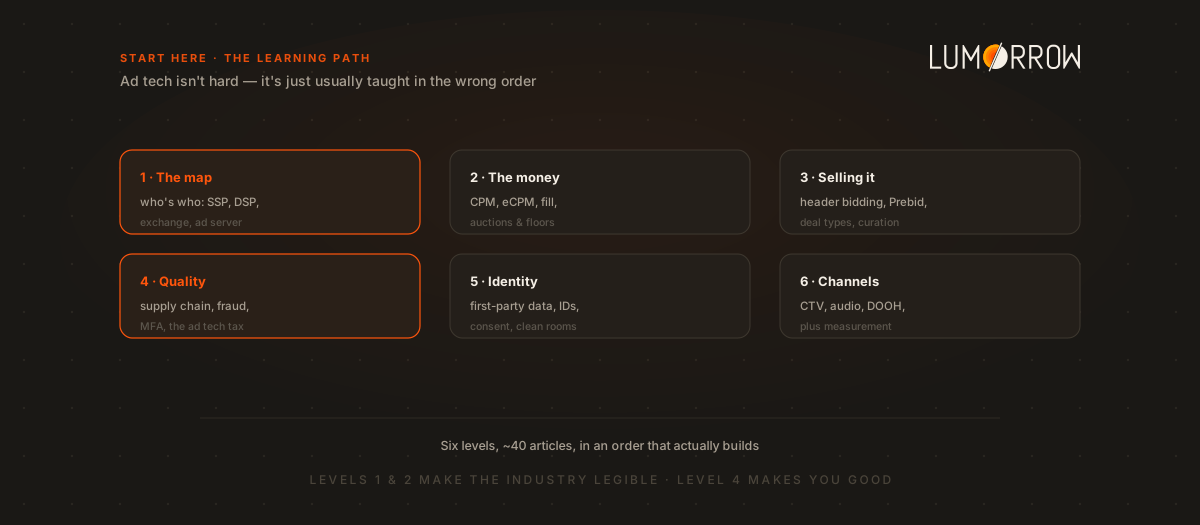
Ad tech is unusually hard to learn, and not because the ideas are difficult. It’s because every explanation assumes five other concepts you haven’t met yet — you look up “bid shading,” which requires first-price auctions, which requires header bidding, which requires knowing what an SSP is.
The fix is order. This is a structured path through the field: six levels, each building on the last. Read it front to back and the whole picture assembles itself. Already know the basics? Skip to the level that’s fuzzy.
If you just need a quick definition instead, use the glossary.
Level 1 — The map
Start with who’s who. Everything else hangs off this.
- SSP vs DSP vs ad exchange — the single most important piece. The seller’s tech, the buyer’s tech, and the auction between them.
- OpenRTB and real-time bidding — how one impression gets auctioned in ~100 milliseconds, and the shared language that makes it possible.
- Ad servers explained — the system that actually decides and delivers the final ad.
- Ad networks vs ad exchanges — where programmatic came from, and why the auction won.
- Ad tech vs mar tech — how paid media relates to the rest of marketing technology.
Level 2 — How the money works
Now that you know the players, learn how an impression is priced. This is the commercial core.
- CPM vs CPC vs CPA — what the advertiser is actually paying for, and who carries the risk.
- Understanding eCPM — the headline publisher metric, and why the average misleads.
- Fill rate explained — the other half of the revenue equation.
- First-price vs second-price auctions — the 2019 switch that changed everyone’s incentives.
- Bid shading — why buyers never bid what they’d really pay.
- Dynamic floor pricing — the publisher’s most direct lever, and the answer to shading.
- Yield optimization — pulling all those levers together.
Level 3 — How inventory is sold
- Header bidding explained — how publishers create real competition for each impression.
- Prebid explained — the open-source machinery most header bidding runs on.
- Auction timeouts and latency — the stopwatch every auction runs against.
- Programmatic deal types — open exchange, PMP, preferred, and guaranteed.
- Curation and curated marketplaces — how quality is being packaged on the sell side.
Level 4 — Quality, fraud & the supply chain
This is the level most people skip, and the one that separates competent operators from the rest.
- Supply-chain transparency — the state of knowing who’s really selling an impression.
- ads.txt and sellers.json — the plain-text files that make the chain verifiable.
- Supply path optimization — choosing the cleanest route to inventory.
- The state of ad fraud — where invalid traffic stands and how it’s evolving.
- Made-for-advertising (MFA) sites — the junk quietly draining budgets.
- Malvertising — when the ad chain becomes an attack vector.
- Brand safety and suitability — keeping ads away from the wrong content without over-blocking.
- The ad tech tax — where the programmatic dollar actually goes.
- Traffic shaping — cutting waste out of the bidstream.
Level 5 — Identity, data & privacy
The area changing fastest. Read Level 4 first; supply quality and identity are deeply linked.
- First-party data — the asset that outlasts the cookie.
- Privacy Sandbox state of play — where the cookieless transition actually stands.
- Cookie syncing — the mechanism that’s ending, and why it mattered.
- Identity resolution and universal IDs — the competing replacements.
- Cross-device tracking and identity graphs — one person, many screens.
- Consent management, GDPR & CCPA — the legal layer that governs all of it.
- DMP vs CDP — the two data platforms and why the CDP is ascendant.
- Data clean rooms — matching data without exposing it.
- Seller-defined audiences — publisher-declared cohorts, no user ID required.
Level 6 — Targeting, channels & measurement
- Audience targeting types — the full menu, and which methods survive the cookie.
- Contextual advertising · Retargeting · DCO · Native advertising
- Channels: CTV → SSAI → VAST & VPAID → ad pods → FAST channels → linear TV. Then in-app, in-game, audio, DOOH, retail media, and walled gardens.
- Measurement: viewability → attention metrics → video metrics → incrementality → media mix modeling. Plus frequency capping and ad blocking.
- Ad operations — the daily work that makes all of it actually run.
Where the field is heading
Once the fundamentals are in place, the frontier is worth understanding:
- Agentic buyers in the bidstream — when “block all bots” stops working.
- Agent-to-agent media buying — the deal itself going machine-to-machine.
- SupplyChain 1.1 — making the hops that don’t get paid visible.
- Sustainability in ad tech — why the green fix is the efficiency fix.
How to use this
Don’t try to read all forty in one sitting. Levels 1 and 2 in one go will make industry conversations legible — that’s a couple of hours. Level 3 makes you useful on the sell side. Level 4 is what makes you genuinely good, because most people never learn it. Levels 5 and 6 you can read as needed, when a project demands them.
And keep the glossary open in a tab while you read.
Lumorrow is an AI-native exchange that evaluates supply quality and sets floors in real time, pre-auction — before the impression is ever billed. See how the platform works →.