
Media mix modeling (MMM) explained: measuring marketing without tracking people
Media mix modeling uses statistics to estimate how each channel contributes to sales — without tracking individuals. Here's how MMM works, how it differs from attribution, and why the privacy era brought this decades-old method back.
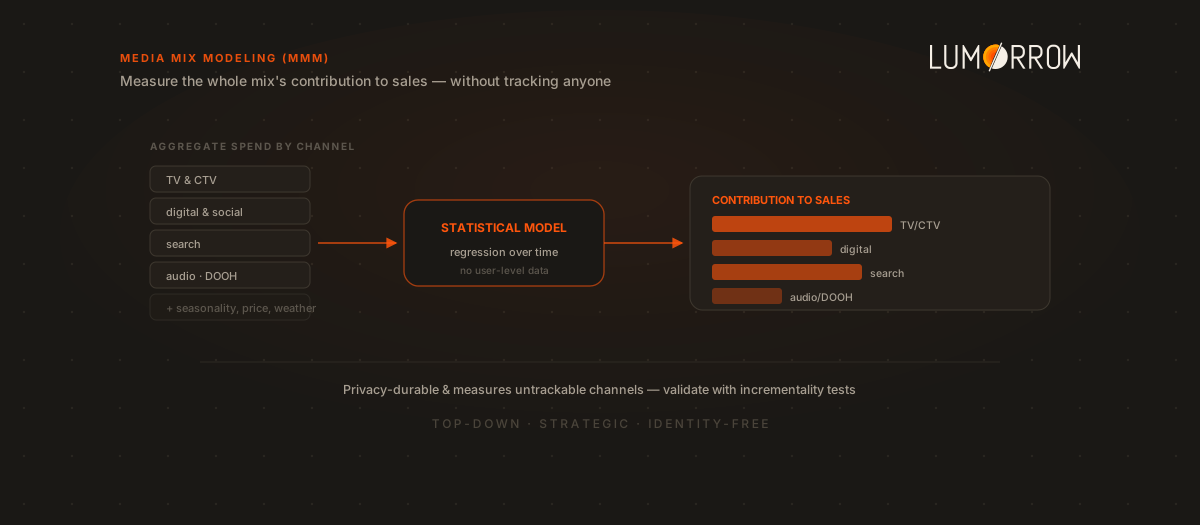
One of the oldest measurement techniques in marketing is having a major revival, and the reason is privacy. Media mix modeling (MMM) predates digital advertising entirely — it’s how brands measured TV, print, and radio for decades — and because it needs no individual tracking at all, it’s become newly essential as cookies and device IDs fade. Understanding MMM rounds out the modern measurement picture.
Here’s what MMM is and why it’s back.
What media mix modeling is
Media mix modeling is a statistical method that estimates how much each marketing channel contributes to business outcomes (sales, revenue) by analyzing aggregate historical data over time. Instead of following individuals, it looks at the big picture: how did total sales move as spending across TV, digital, social, CTV, search, and other channels went up and down?
Using regression and related techniques, MMM separates the effect of each channel from everything else moving the business — seasonality, promotions, pricing, economic conditions, even weather — to estimate each channel’s contribution and diminishing returns.
Crucially, it works entirely on aggregate data: total spend and total outcomes by time period and region. No user-level tracking, no cookies, no identity graph.
MMM vs. attribution vs. incrementality
The three main measurement approaches answer different questions at different altitudes:
- Attribution — user-level and fast; credits specific touchpoints for specific conversions. Granular but causally naive and identity-dependent.
- Incrementality — experimental; measures the true causal lift of a specific tactic via holdout tests. Causally clean but narrow in scope.
- MMM — top-down and strategic; estimates how all channels contribute to the whole business over time, including hard-to-track ones like TV and out-of-home. Broad and privacy-safe but low-resolution and slow.
Attribution zooms into a single conversion. Incrementality runs a clean experiment on one tactic. MMM pulls back to the whole business and asks how the entire mix drives outcomes — without ever needing to know who anyone is.
Why the privacy era revived it
MMM was somewhat sidelined during the peak-cookie years, when granular user-level attribution felt more precise and immediate. Two forces brought it back:
- Signal loss. As third-party cookies and device IDs disappear, user-level attribution gets patchier and less trustworthy. MMM never depended on those signals, so it’s unaffected — a durable measurement floor.
- Cross-channel reality. Modern budgets span digital, CTV, linear TV, audio, and DOOH — much of it impossible to track at the individual level. MMM measures all of it in one framework because it only needs spend and outcome data.
Modern MMM has also improved — faster refreshes, better statistical methods, and increasingly automated tooling — making it more actionable than the once-a-year exercise it used to be.
The trade-offs
MMM isn’t magic. It’s correlational (it can be validated and strengthened with incrementality experiments), it needs a good amount of clean historical data, it’s low-resolution (channel-level, not campaign- or creative-level), and it’s only as good as the model and the data behind it. That’s why the best measurement stacks triangulate: MMM for strategic budget allocation, incrementality to validate causal effects, and attribution for fast tactical signals.
The takeaway
Media mix modeling uses aggregate historical data and statistics to estimate how each channel contributes to business outcomes — without tracking a single individual. That privacy-by-design property, plus its ability to measure untrackable channels like TV and out-of-home in one framework, is why this decades-old method is essential again in the cookieless era. Use it for the strategic view of your whole mix, validate it with incrementality tests, and pair it with attribution for tactical speed.
Lumorrow focuses on the real-time, pre-auction layer — ensuring the impressions feeding any measurement model are valid and quality. See how the platform works →.