
Linear TV advertising explained: how traditional TV buying works — and where it's converging with CTV
Linear TV is scheduled, one-to-many television — bought against programs and ratings, not impressions. Here's how traditional TV buying actually works (GRPs, upfronts, dayparts), how it differs from CTV, and what convergence really changes.
Everything in digital advertising is described in contrast to “traditional TV” — but most people who grew up in programmatic have never actually learned how traditional TV is bought. That’s a gap worth closing, because linear TV still commands tens of billions in annual spend, and its slow merger with CTV — “converged TV” — is one of the defining stories in video.
Here’s how linear TV advertising actually works, and what convergence does and doesn’t change.
What linear TV is
Linear TV is scheduled television — broadcast and cable programming that airs at a set time on a set channel, watched live or near-live by everyone tuned in. The name comes from the linear programming schedule: content flows in one fixed sequence, and the audience comes to it.
Structurally, it’s the opposite of digital in two ways:
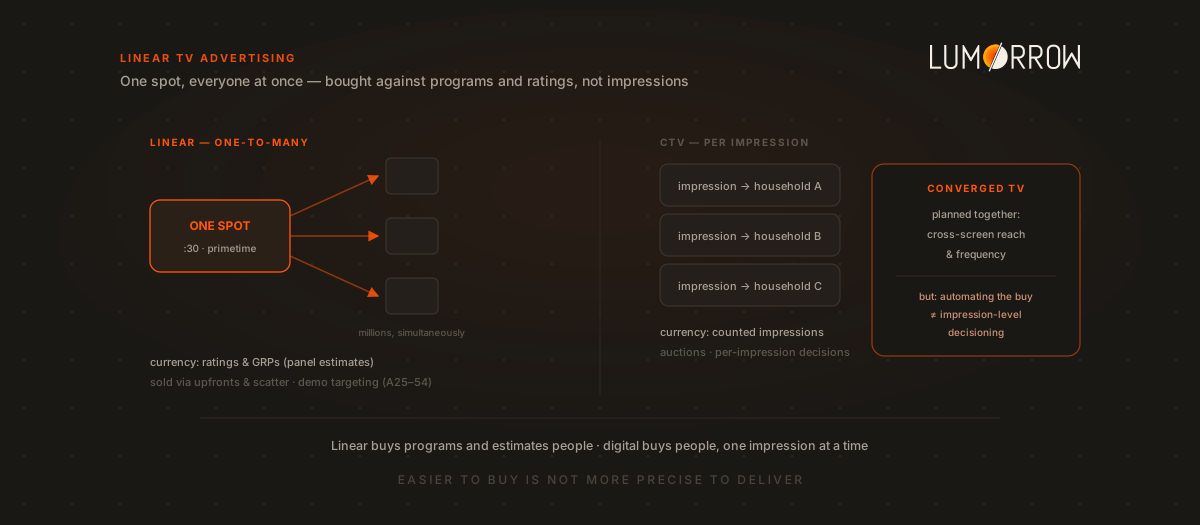
- One-to-many. A linear ad airs once and reaches everyone watching that program at that moment — one spot, millions of simultaneous viewers. There is no per-viewer decision. (The same one-to-many logic as DOOH, at national scale.)
- Bought against programs, not people. You don’t buy an impression; you buy a spot — 15 or 30 seconds in a specific program, on a specific network, in a specific daypart (primetime, daytime, late night).
How linear TV is traditionally bought
Linear buying has its own vocabulary, and it’s worth knowing because the entire digital measurement debate is a reaction to it:
- Ratings and GRPs. The currency of linear is the rating point — the percentage of a target demographic estimated (by panel-based measurement) to have watched. A campaign’s weight is expressed in GRPs (gross rating points): reach × frequency across the schedule. Where digital counts impressions, linear estimates audiences.
- Demo targeting. Linear targets broad demographics — the famous “adults 25–54” — because panel measurement can’t see individuals, only representative samples. All the precision of digital audience targeting exists precisely because linear couldn’t do this.
- Upfronts and scatter. The bulk of premium linear inventory is sold in the upfront — an annual marketplace where advertisers commit budgets months in advance for guaranteed audience delivery, at negotiated rates. What’s left is sold closer to air date in the scatter market, usually at higher prices. Think of it as the original programmatic guaranteed: committed volume, negotiated price, reserved inventory — just done over dinners instead of deal IDs.
- Make-goods. If a program under-delivers its guaranteed audience, the network compensates with free spots — the linear version of an under-delivery clause.
Linear buys programs and estimates people. Digital buys people and estimates almost nothing. That single difference — panel-measured audiences vs. counted impressions — explains most of how differently the two worlds work.
Linear vs. CTV: the real differences
Put side by side, the contrast is sharp:
- Unit of purchase: linear buys a spot in a program; CTV buys an individual impression in a stream.
- Targeting: linear reaches a broad demo across everyone watching; CTV can target household-level attributes per impression.
- Measurement: linear is panel-based estimation (ratings); CTV is impression-counted — though with its own measurement challenges.
- Buying mechanics: linear runs on upfront commitments and insertion orders; CTV runs on real-time auctions and programmatic deals.
- What linear still does best: massive, simultaneous, high-attention reach — live sports and big cultural moments remain linear’s stronghold, delivering audiences at a scale and immediacy streaming still struggles to match.
Convergence: what’s actually changing
“Converged TV” is the industry’s term for treating linear and CTV as one video ecosystem rather than separate silos. Two real shifts are underway:
- Linear is becoming automatable. Industry-wide, linear inventory is increasingly plannable and transactable through the same automated, data-informed pipes as digital — bringing programmatic-style workflow (audience-based planning, automated execution) to a medium built on phone calls and insertion orders.
- Cross-screen planning is becoming the norm. Buyers increasingly plan linear and streaming together — managing reach and frequency across both, so the same household isn’t hammered on cable and then again in streaming, and incremental reach is bought where it’s cheapest.
But here’s the honest caveat that most convergence coverage skips: automating the transaction is not the same as impression-level decisioning. A linear spot bought programmatically is still one ad airing to everyone at once — easier to buy, not more precise to deliver. The per-impression evaluation that defines digital — every request assessed and priced individually, pre-auction — only exists on the streaming side of the converged world. Convergence is narrowing the workflow gap; the decisioning gap remains.
The takeaway
Linear TV is scheduled, one-to-many television bought against programs and panel-measured ratings — GRPs, dayparts, upfronts — rather than counted impressions. It’s structurally the opposite of digital, still unmatched for simultaneous mass reach, and steadily converging with CTV into a single planned-together video market. Just keep the distinction straight: convergence is making linear easier to buy through automated pipes, but true per-impression decisioning still lives only where the impression exists — in streaming. Understanding both sides is what “TV expertise” now means.
Lumorrow brings real-time, per-impression intelligence to the side of converged TV where impressions exist — evaluating quality and value pre-auction across CTV and OTT. Explore CTV & OTT solutions → or see how the platform works →.