
Programmatic deal types explained: open exchange, PMP, preferred, and guaranteed
Not all programmatic is an open auction. Private marketplaces, preferred deals, and programmatic guaranteed give buyers and publishers more control and premium inventory. Here's how the four deal types differ and when each is used.
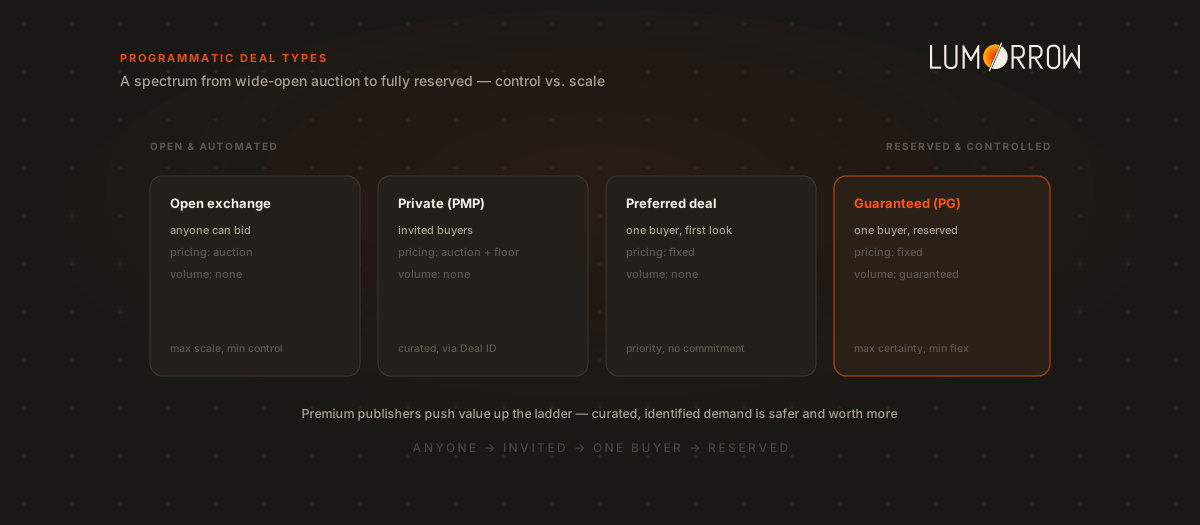
When people say “programmatic,” they usually picture the open auction — anyone can bid on anything. But that’s only one of four ways programmatic inventory is bought and sold, and for premium publishers it’s often the least important one. The other three trade some of the auction’s openness for control, transparency, and better inventory.
Here’s how the four programmatic deal types work, ordered from most open to most locked-down.
1. Open exchange (the open auction)
The open exchange is the classic real-time auction: a publisher’s impression is offered to all connected buyers, and the highest bid wins. It’s fully automated, enormous in scale, and priced purely by auction dynamics.
- Access: open to essentially any buyer.
- Pricing: dynamic, set by the auction.
- Best for: monetizing the long tail of inventory at scale.
- Trade-off: least control, least transparency for the publisher about who is buying — and the environment where fraud and quality issues concentrate.
2. Private marketplace (PMP)
A private marketplace (PMP) is an invitation-only auction. A publisher opens a specific pool of inventory to a curated set of buyers, often at a negotiated floor, identified by a Deal ID.
- Access: invited buyers only.
- Pricing: an auction, but with a negotiated floor and known participants.
- Best for: premium inventory a publisher wants to sell programmatically without throwing it open to everyone.
- Trade-off: more control and transparency than the open exchange, still with auction efficiency.
3. Preferred deal
A preferred deal is a fixed-price arrangement with no auction, but no volume commitment either. A publisher offers specific inventory to a specific buyer at a pre-agreed price, giving that buyer a first look — they can take the impression at the set price or pass, in which case it flows on to other demand.
- Access: one buyer, first right of refusal.
- Pricing: fixed, negotiated in advance.
- Best for: giving a valued buyer priority access without locking in guaranteed volume.
- Trade-off: predictable pricing; no guaranteed spend or delivery.
4. Programmatic guaranteed (PG)
Programmatic guaranteed (PG) is the most locked-down: a fixed price and a guaranteed volume, executed through programmatic pipes. It’s essentially a traditional direct-sold deal — reserved inventory, committed spend — but automated so it runs through the same machinery instead of manual insertion orders.
- Access: one buyer, reserved inventory.
- Pricing: fixed price, guaranteed volume.
- Best for: premium, reserved campaigns that want direct-deal certainty with programmatic efficiency.
- Trade-off: maximum certainty for both sides; minimum flexibility.
The four types are a spectrum from open to reserved: open exchange (anyone, auction) → PMP (invited, auction) → preferred (one buyer, fixed price, no commitment) → programmatic guaranteed (one buyer, fixed price, committed volume).
Why the deal type matters
The deal type shapes almost everything a publisher cares about: price predictability, who’s allowed to buy, how transparent the transaction is, and how much fraud risk rides along. Premium publishers increasingly push value up this ladder — into PMPs, preferred deals, and PG — because curated, identified demand is safer and more valuable than the open free-for-all. That shift is the same “curation” trend reshaping supply-chain transparency and supply path optimization.
The takeaway
Programmatic isn’t one marketplace — it’s four, ranging from the wide-open auction to fully reserved guaranteed deals. Open exchange maximizes scale, PMPs add curation, preferred deals add fixed pricing, and programmatic guaranteed adds committed volume. Knowing which lever you’re pulling — and pushing premium inventory toward the more controlled end — is one of the most important decisions in monetization.
Lumorrow brings real-time, pre-auction intelligence to every deal type — evaluating quality and setting floors whether inventory trades in the open exchange or a private deal. See how the platform works → or explore it as a publisher →.