
CTV advertising explained: how connected TV buying actually works
Connected TV is the fastest-growing corner of programmatic — and the most confusing. Here's how CTV advertising actually works: the supply chain, the formats, SSAI, and why measurement and fraud are harder here than anywhere else.
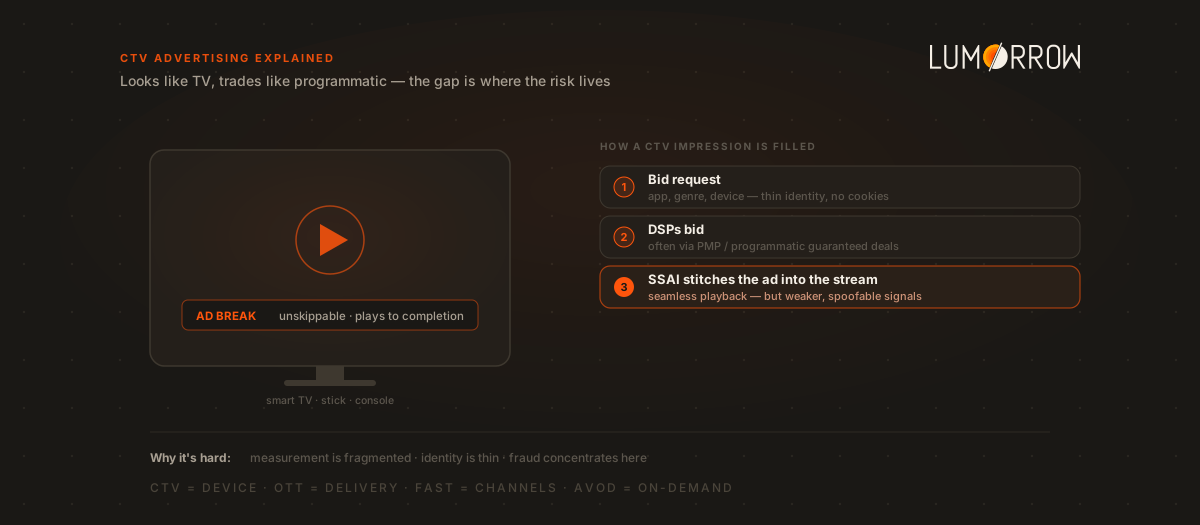
Connected TV is the fastest-growing part of programmatic — roughly 17% of US programmatic display spend in 2026 and climbing. It’s also the most misunderstood. CTV looks like TV and trades like programmatic, and the gap between those two mental models is where most of the confusion (and the risk) lives.
Here’s how CTV advertising actually works, end to end.
What “CTV” actually means
Connected TV is any television set connected to the internet that streams video — whether through a smart TV’s built-in OS, a streaming stick or box (Roku, Fire TV, Apple TV), or a game console. The ad-supported apps running on those devices are where CTV inventory comes from.
A few terms get used loosely, so it’s worth being precise:
- CTV = the device (the internet-connected TV screen).
- OTT (over-the-top) = the delivery — video served over the internet rather than cable or broadcast.
- FAST (free ad-supported streaming TV) = the channels — linear-style, always-on channels that are free because they’re ad-supported.
Most CTV ad inventory falls into two buckets: AVOD (ad-supported on-demand, like the ad tiers of major streamers) and FAST. Both are streaming, both are ad-supported, and both are increasingly bought programmatically.
How a CTV ad gets bought and served
The buying flow rhymes with display programmatic but has TV-specific twists:
- A viewer starts a stream. Before or during the content, an ad break opens with one or more slots to fill.
- The publisher’s ad server and SSP send a bid request describing the impression — app, content genre, device, geo, and (crucially) far less about the individual than a browser would carry.
- Buyers (DSPs) bid, often against private marketplace (PMP) deals or programmatic guaranteed arrangements rather than the pure open exchange — premium CTV inventory is frequently sold through negotiated deals.
- The winning ad is stitched into the stream and played. Unlike a display ad, a CTV video ad typically can’t be skipped and plays to completion — which is a big part of why CPMs are high.
The high CPMs, the premium context, and the “can’t be closed” format are what make CTV so attractive — and, as we’ll see, so targeted by bad actors.
SSAI: the piece that makes CTV different
The technical heart of CTV is server-side ad insertion (SSAI). Instead of the player calling for an ad (client-side), a server stitches the ad directly into the video stream so it plays seamlessly, indistinguishable from the content, with no buffering between show and ad.
SSAI is what makes streaming ads feel like broadcast TV. But it has a side effect that matters enormously: because the ad request comes from a server rather than an identifiable device in a browser, the signals that verify an impression are weaker and easier to spoof. The same technology that delivers a clean viewing experience also obscures where an impression really came from — which is why CTV is the front line for invalid traffic and ad fraud.
SSAI gives streaming its broadcast-quality polish. It also strips out the browser-level signals that used to prove an impression was real. Convenience and opacity, from the same mechanism.
The formats
CTV isn’t just 30-second spots. The format menu is expanding, and the newer ones are where a lot of untapped value sits:
- Standard in-stream video — the pre-roll / mid-roll spot, played to completion.
- Pause ads — a unit that appears when the viewer pauses. High attention, non-intrusive.
- Interactive ads — QR codes or on-screen prompts that bridge the living room to a phone.
- Shoppable and branded formats — deeper integrations tied to the content experience.
Many of these premium formats are underused for a simple reason: they’ve historically been manual to negotiate and traffic, which caps how much they scale. (That friction is exactly what agentic and agent-to-agent buying is now attacking.)
Why CTV is harder than it looks
Three challenges define CTV, and all three trace back to the same root: it’s TV-quality inventory running on programmatic-quality infrastructure that’s still maturing.
Measurement is fragmented. There’s no single, universal currency for CTV reach and frequency the way there was for linear TV ratings. Cross-app frequency capping and deduplicated reach remain genuinely hard.
Identity is thin. No cookies, no browser — CTV bid requests carry far less about the viewer. Targeting leans on app, content, device, and household-level signals, and increasingly on first-party and contextual data.
Fraud concentrates here. High CPMs, opaque SSAI delivery, and immature verification make CTV the highest-value target for spoofing. As we covered in the 2026 state of ad fraud, CTV fraud schemes have grown sharply — and even direct deals aren’t automatically clean.
The takeaway
CTV advertising works like premium video programmatic with a TV soul: high-value, unskippable inventory, sold heavily through deals, stitched in via SSAI. The upside is real and growing. But the same traits that make it attractive — high prices, opaque delivery, thin identity — are exactly what make quality, measurement, and fraud harder here than anywhere else in the funnel. Buying CTV well means treating supply quality and impression validity as first-class questions, not afterthoughts.
Lumorrow evaluates supply quality and traffic validity in real time, pre-auction, across web, CTV, and OTT — where the signals are thinnest and the stakes are highest. Explore CTV & OTT solutions → or see how the platform works →.