
The cookieless deadline that never arrives: Privacy Sandbox, mid-2026
Google stopped trying to kill the third-party cookie — but the cookie is dying anyway, just unevenly. Where Privacy Sandbox, alternative IDs, and first-party data actually stand for publishers in mid-2026.
For five years, the entire ad industry organized itself around a date. The third-party cookie was going away in Chrome — first in 2022, then 2023, then 2024, then “early 2025” — and every identity vendor, clean room, and contextual startup pitched against that countdown.
Then the countdown stopped. In 2025 Google abandoned the plan to force a deprecation, settling instead on a user-choice prompt and leaving the third-party cookie in place by default. The deadline everyone planned around simply dissolved.
It would be easy to read that as “the cookie won, nothing changed.” That’s the wrong lesson. The cookie is still dying — just unevenly, driven by browsers and regulators rather than a single Chrome switch. Here’s where identity actually stands in mid-2026, and why “wait and see” is quietly the riskiest position a publisher can hold.
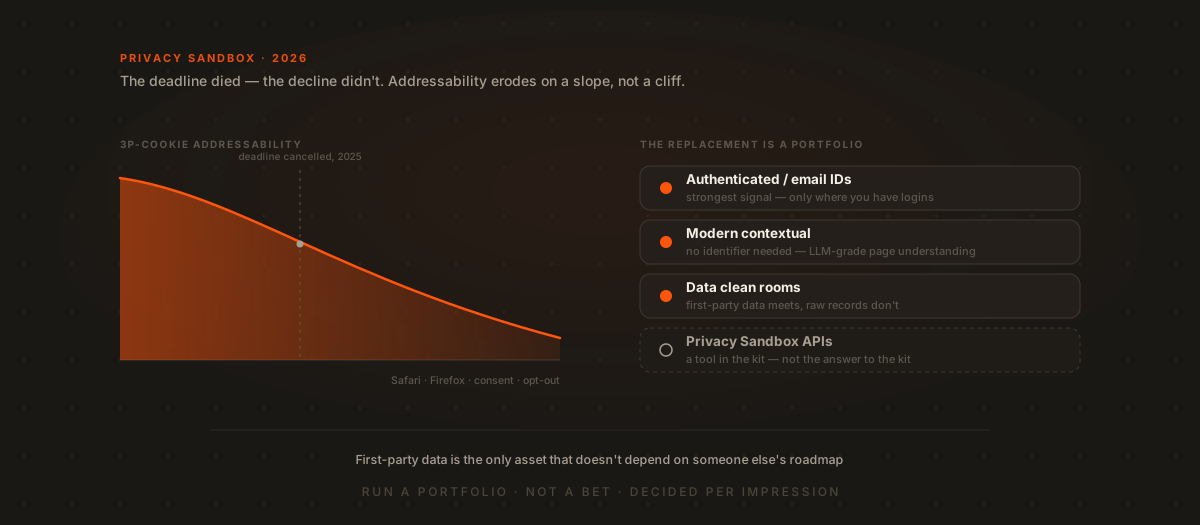
The deadline died. The decline didn’t.
Chrome kept the cookie, but Chrome was never the whole web. The signal loss publishers feared arrived anyway, through every other door:
- Safari and Firefox have blocked third-party cookies by default for years. That’s already a large share of traffic — and a disproportionately valuable one — addressed without third-party identifiers.
- Regulation keeps tightening. Consent requirements across the EU, UK, and a growing list of US states mean a meaningful slice of even Chrome traffic is non-addressable by the time consent strings are honored.
- Users opt out. Where a choice prompt exists, a real fraction takes it.
The net effect: addressability didn’t fall off a cliff on one date. It’s eroding on a slope. The publishers who built their 2025 plans entirely around “Chrome isn’t deprecating after all” are optimizing for the one browser that changed the least.
The deadline was a distraction. The decline is the actual story — and it never needed Google’s permission to continue.
What actually happened to Privacy Sandbox
Privacy Sandbox was Google’s proposed replacement: a set of browser APIs — Topics for interest signals, Protected Audience for remarketing, Attribution Reporting for measurement — meant to do programmatic’s core jobs without cross-site tracking.
With deprecation off the table, the Sandbox’s status is murkier. The APIs still ship in Chrome, but the existential urgency that drove adoption evaporated when the cookie stopped going away. Buyers and sellers who spent years testing Topics and Protected Audience are left with working-but-optional tooling and no forcing function. Some pieces — particularly on the measurement side — remain genuinely useful; others are stalled in a limbo of “available, lightly used.”
The practical takeaway for publishers: Privacy Sandbox is a tool in the kit, not the answer to the kit. Treating it as the single successor to the cookie was always a bet on a deadline that no longer exists.
The alternative-ID landscape
With no single mandated replacement, the identity market fragmented into a field of competing approaches — and publishers now have to bet across several:
- Authenticated / email-based IDs. The strongest signal, anchored in logged-in users and hashed emails. Powerful where you have authentication, useless where you don’t — which is most of the open web’s long tail.
- Probabilistic and cohort IDs. Modeled audiences that trade precision for reach. Useful for scale, weaker for the high-value targeting buyers pay up for.
- Contextual targeting. The original cookieless method, now meaningfully better thanks to modern language models that understand page content far past keyword matching. Durable because it needs no user identifier at all.
- Data clean rooms. Where publisher and advertiser first-party data meet without either side exposing raw records. Increasingly the venue for premium, privacy-safe deals.
No single one of these reaches the coverage the third-party cookie once did. The 2026 reality is a portfolio: publishers stitch authenticated IDs where they have logins, contextual everywhere else, and clean rooms for their biggest partners.
First-party data is the only durable asset
Strip away the acronyms and one conclusion survives every scenario: the data you own, with consent, is the asset that doesn’t depend on anyone else’s roadmap.
A logged-in relationship, a consented email, a behavioral profile built on your own properties — none of that is at the mercy of a browser default or a regulator’s next move. Publishers who spent the cookie-countdown years building authenticated audiences and first-party data infrastructure are now positioned regardless of which identity approach wins. Those who waited for a standard to emerge are still waiting, with a thinner asset base than when they started.
What to actually do in mid-2026
The absence of a deadline is not the absence of pressure. It’s a removal of the excuse to wait.
-
Stop planning around a Chrome date. It isn’t coming. Plan around the slope: addressability that keeps eroding across Safari, Firefox, regulation, and consent.
-
Invest in first-party data like the cookie is already gone — because on most of your traffic, it effectively is. Authentication, consented email capture, and on-site behavioral signal are the durable layer.
-
Run a portfolio, not a bet. Authenticated IDs where you have logins, modern contextual everywhere else, clean rooms for premium partners. Don’t wait for one winner.
-
Treat consent as infrastructure, not compliance. A consent string you honor cleanly is what makes your first-party data usable across the portfolio. Sloppy consent quietly shrinks your addressable base.
-
Make sure your supply path doesn’t leak identity. Privacy-safe targeting is worthless if your inventory still passes identifiers through unverified hops. Identity hygiene and supply-chain hygiene are the same project now.
Identity belongs in the auction, not bolted on after
The thread running through all of this: there’s no longer a single identifier you can attach to an impression and call it addressable. Value now comes from reasoning, in real time, about what’s actually known about a request — which signals are present, which are consented, which are durable — and pricing it accordingly.
That’s a decision that has to happen inside the auction, on every bid request, not in a quarterly review of which identity vendor to standardize on. The cookie’s slow decline didn’t make identity simpler; it made it a per-impression judgment. The exchanges that win the cookieless era — whenever, exactly, it finishes arriving — are the ones that can make that judgment in the moment, before the impression is ever sold.
Lumorrow evaluates the signals available on each bid request — consented identity, context, and supply quality — in real time, pre-auction, across web, CTV, and OTT. See how the platform works → or explore it as a publisher →.