
Agent-to-agent media buying is here — and it needs a protocol, not a pitch
For 15 years machines ran the auction while humans set up the deal. That's flipping. Buyer agents are now negotiating directly with seller agents — and the real story isn't the AI, it's the protocol layer forming underneath it. CTV is the first proving ground.
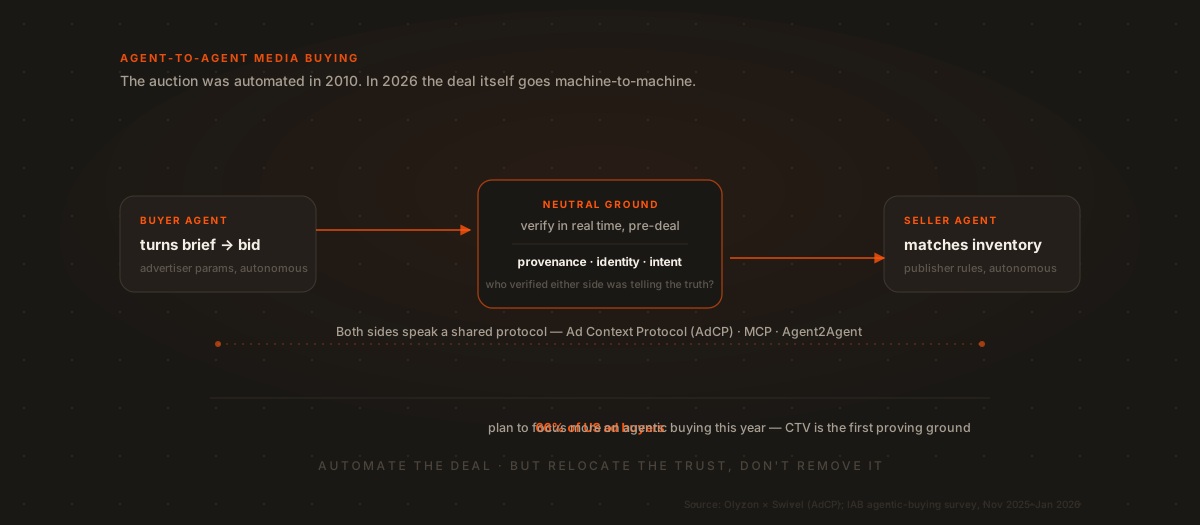
For fifteen years, programmatic drew a clean line. Machines ran the auction — the microsecond bidding, the clearing, the pacing. But humans set up the deal — the briefs, the negotiations, the “can you match this CPM on that inventory” back-and-forth that happens over email and in meetings before a single bid request fires.
That line is now dissolving. The newest move in ad tech isn’t a faster auction. It’s the deal itself going agent-to-agent — a buyer’s AI agent negotiating directly with a seller’s AI agent, no human in the loop for the parts that used to take a week.
This is a genuinely new phase, and it’s easy to get distracted by the wrong part of it. The headline is “AI agents are buying media now.” The actual story — the part with a decade-long tail — is the protocol layer quietly forming to let those agents talk to each other at all.
What actually happened
The concrete moves landed fast:
- Olyzon (buy-side) and Swivel (sell-side) partnered on true agent-to-agent media buying. Olyzon’s buyer agents turn advertiser parameters into creative briefs, then talk directly to Swivel’s seller agents to find matching inventory — both sides speaking the Ad Context Protocol (AdCP), a shared language for LLM-based agents to negotiate a deal.
- PubMatic’s AI agents planned and ran a real programmatic CTV media buy with agency Butler/Till — not a demo, an actual campaign.
- The demand is already there: an IAB survey (Nov 2025–Jan 2026) found 66% of US ad buyers plan to focus more on agentic ad buying this year.
Notably, humans haven’t left the room — yet. In these early workflows, publishers still review and approve agent-negotiated deals before they schedule, and buyers still sign off on creative while agents validate the specs. That human checkpoint is real. It’s also, obviously, the first thing that gets optimized away as trust builds.
Why CTV is the first proving ground
It’s not an accident that connected TV is where this is being tested first. CTV is now 17.2% of US programmatic display spend in 2026 — big enough to matter, and structurally the most manual corner of programmatic.
Premium CTV runs on custom deals, content-adjacency requirements, and guaranteed delivery — coordination that today burns human hours across disconnected systems. As one operator put it, “when execution can’t keep pace with opportunity, inventory value is constrained not by demand but by the ability to make quick, consistent decisions.” That’s the tell: CTV’s ceiling isn’t demand, it’s execution friction. Formats like pause ads and interactive units are valuable and underused precisely because negotiating them by hand doesn’t scale.
Agents attack exactly that bottleneck — encoding a publisher’s business rules into an autonomous negotiator that applies them consistently, at machine speed, without a standing meeting. CTV has the most to gain because it had the most friction to remove.
The auction was automated in 2010. The deal is being automated in 2026. That’s a bigger change than it sounds — because the deal is where trust used to live.
The real story is the protocol, not the AI
Here’s the part most coverage skips. Two agents can’t negotiate unless they speak the same language. The durable shift isn’t that agents are smart — it’s that they’re converging on shared protocols to transact: ad-native ones like the Ad Context Protocol (AdCP), sitting on top of the general-purpose agent-interoperability layer the whole software industry is standardizing on (Model Context Protocol, Agent2Agent).
If that sounds familiar, it should. This is an OpenRTB moment. In 2010, a shared bid-request spec turned a mess of point-to-point integrations into an interoperable market — and whoever understood the protocol early shaped the decade that followed. Agent-to-agent trading is at the same inflection: the protocol that wins becomes the rails everything else runs on. Betting on the AI vendor is betting on a product. Understanding the protocol is understanding the market.
The hard part: trust when both sides are machines
Automating the deal removes the human friction. It also removes the human judgment that used to sit in that friction — the account manager who knew a path looked wrong, the buyer who paused on a CPM that was too good to be true.
When a buyer agent negotiates with a seller agent, every question we raised in the agentic-buyers piece comes back doubled. There, the question was “is this traffic a real customer or a fraud bot?” Now it’s on both sides of the table at once:
- Is the seller agent representing inventory that’s actually real, on the path it claims? (The supply-chain and schain 1.1 questions, now negotiated by a machine.)
- Is the buyer agent who it says it is, acting for the advertiser it claims, with the intent it declares?
- When two autonomous agents agree on a deal in milliseconds, who verified that either one was telling the truth?
Human approval is the current answer, and it’s a good one — until volume makes it a rubber stamp. The moment agent-to-agent buying scales past what humans can meaningfully review, the trust has to move into the transaction itself: provenance, identity, and intent, checked in real time, not vouched for after the fact.
What to actually do
-
Track the protocols, not just the tools. AdCP, MCP, Agent2Agent — the standard that wins is the rails for the next decade. Read them the way smart operators read OpenRTB in 2010.
-
Start in CTV, where the friction-to-value ratio is highest. If you’re a publisher, the premium formats you under-monetize because they’re manual to sell are exactly where agentic buying pays off first.
-
Don’t let human approval become a rubber stamp. It’s the right control today. Design now for the day it can’t scale — which means verification that lives in the transaction, not in a person’s inbox.
-
Assume the counterparty is a machine. Both sides of the deal are becoming autonomous. Any trust model that relies on “a person would have caught that” is already on borrowed time.
Someone has to be the neutral ground
Agent-to-agent buying is a real efficiency unlock, and CTV is the right place to prove it. But automating the deal doesn’t remove the need for trust — it relocates it. The judgment that used to live in human negotiation has to go somewhere, and “we’ll approve it manually” only holds until the volume it’s meant to enable arrives.
When both the buyer and the seller are autonomous agents optimizing for their own side, the transaction needs neutral ground — a layer that verifies provenance, identity, and intent in real time, before the deal is struck, not after. That’s the conviction Lumorrow is built on: as the deal itself becomes machine-to-machine, the exchange has to be the place that reasons about whether it should happen at all — pre-transaction, on every request, for a market where a person is no longer in the loop to catch what’s wrong.
Lumorrow evaluates provenance, identity, and intent on every request in real time, pre-auction, across web, CTV, and OTT — built for a market where both sides of the deal are increasingly autonomous. See how the platform works → or explore it for demand partners →.