
Ad viewability explained: what counts as a seen ad, and why it's contested
An ad that serves isn't an ad that's seen. Viewability measures whether an impression actually had a chance to be viewed. Here's the standard, how it's measured, where it falls short, and why attention metrics are pushing past it.
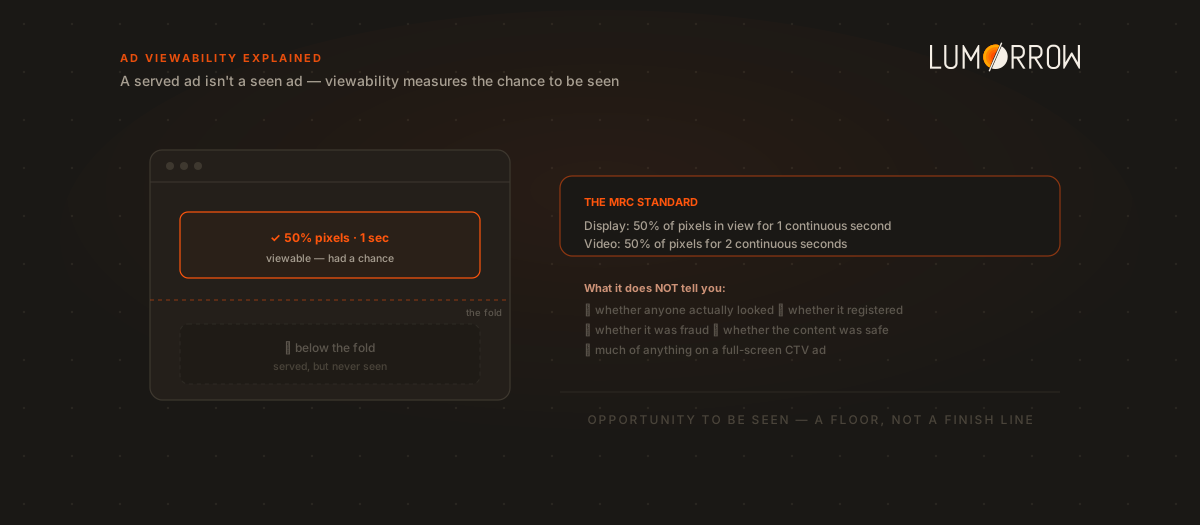
For most of digital advertising’s history, a “served” impression counted as a delivered ad — even if it loaded below the fold and no human ever scrolled to it. Viewability was the industry’s attempt to fix that obvious problem: to measure whether an ad actually had a chance to be seen. It’s essential, widely used, and — as we’ll see — only a partial answer.
Here’s what ad viewability means, how it’s measured, and where it falls short.
What viewability actually measures
Viewability measures whether an impression met a minimum threshold of being on-screen. The widely-adopted MRC (Media Rating Council) standard defines a viewable display impression as:
- at least 50% of the ad’s pixels in view,
- for at least one continuous second.
For video, the bar is 50% of pixels in view for at least two continuous seconds. Larger display units have their own thresholds.
The critical thing to understand is what viewability does not claim. It doesn’t mean anyone looked at the ad, read it, or remembered it. It means the ad had a genuine opportunity to be seen. That’s a meaningful floor — it filters out ads that literally never rendered on-screen — but it’s a low bar.
Viewability answers “could this ad have been seen?” — not “was it actually seen, and did it register?” It’s a measure of opportunity, not attention.
How it’s measured
Viewability is tracked by measurement code — from the ad server or an independent verification vendor — that reports how much of the ad was on-screen and for how long. Independent, third-party measurement matters here: a platform grading its own viewability is a conflict of interest, which is why buyers lean on neutral verification vendors.
That measurement isn’t perfect. Technical limitations, especially in hard-to-measure environments, mean a meaningful share of impressions come back as “unmeasurable” — and how those get counted materially affects the numbers.
Where viewability falls short
Viewability was a big step up from counting served impressions, but it has real gaps:
- A viewable ad is not a seen ad. An impression can clear the 50%-for-1-second bar while the user scrolls right past it. Opportunity isn’t attention.
- It’s gameable. Layouts can technically satisfy the pixel-and-time thresholds without genuinely surfacing the ad to a user — sticky slots, stacked placements, autoplay tricks.
- It says nothing about quality. A viewable impression can still be fraudulent, served next to bad content, or shown to a bot that “views” perfectly. Viewability and validity are different questions.
- CTV complicates it. On a full-screen TV ad the pixel test is trivially met, so viewability tells you almost nothing there — a different measurement problem entirely.
Why attention metrics are emerging
Because viewability only measures opportunity, the industry has been moving toward attention metrics — signals like time in view, scroll velocity, and interaction that try to estimate whether an ad was actually attended to, not just technically on-screen. Attention is the attempt to measure the thing viewability was always a proxy for.
The takeaway
Ad viewability measures whether an impression met a minimum on-screen threshold — the MRC standard of 50% of pixels for one second (two for video). It’s a genuine improvement over counting served impressions, and it’s table stakes for any serious buyer. But it measures opportunity to be seen, not attention, not quality, and not validity. Treat it as a necessary floor, not a finish line — and pair it with fraud controls and attention signals to understand what an impression is really worth.
Lumorrow evaluates impression quality and validity in real time, pre-auction — so the impressions you transact on are worth measuring in the first place. See how the platform works → or read the eCPM guide →.