
Attention metrics explained: measuring whether an ad was actually noticed
Viewability tells you an ad could have been seen. Attention metrics try to measure whether it actually was. Here's what attention metrics are, how they're captured, what they get right, and the standardization problem still holding them back.
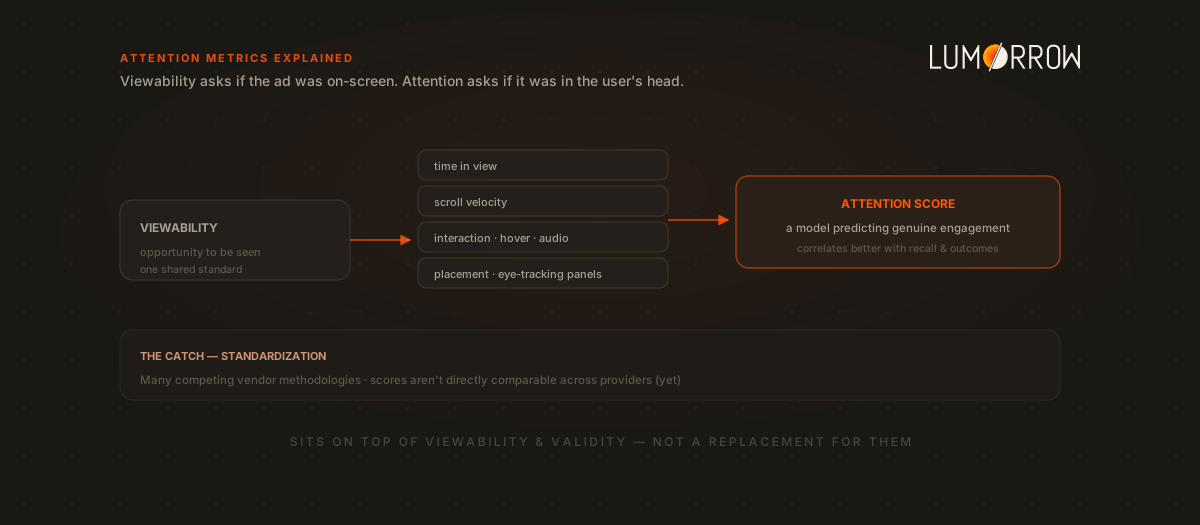
For a decade, viewability was the best answer to “was this ad seen?” But viewability only measures whether an ad could have been seen — 50% of pixels on-screen for a second. It says nothing about whether a human actually noticed it. Attention metrics are the industry’s attempt to close that gap — to measure the thing viewability was always a proxy for.
Here’s what attention metrics are, how they work, and why they haven’t fully replaced viewability yet.
From opportunity to attention
The distinction is the whole story:
- Viewability = opportunity to be seen. Did the ad render on-screen long enough to have a chance?
- Attention = engagement. Given that chance, did a human actually attend to the ad — and for how long?
Two impressions can be equally viewable and worlds apart in attention. One appears for a second as the user scrolls past at speed; the other holds the screen while the user reads. Viewability scores them the same. Attention metrics try to tell them apart.
Viewability asks whether the ad was on the screen. Attention asks whether the ad was in the user’s head. Those are very different questions — and only one of them predicts whether advertising works.
How attention is measured
There’s no single sensor for human attention, so attention metrics are built by combining behavioral signals into a model:
- Time in view — not just past the one-second threshold, but how long the ad genuinely held the screen.
- Scroll velocity — how fast the user moved past the ad (a slow scroll suggests engagement; a blur suggests none).
- Interaction signals — hovers, taps, expansions, audio-on for video, and other active engagement.
- Viewport and placement context — where on the page the ad sat and how much of the screen it commanded.
- Panel and eye-tracking calibration — some vendors calibrate their models against panels of users with real eye-tracking, then extrapolate to the wider population.
No single signal equals attention; the metric is a model trained to predict genuine engagement from the combination.
What attention gets right — and its catch
Done well, attention metrics correlate better with real outcomes (recall, brand lift, sometimes sales) than viewability does. That’s the promise: optimize toward attention and you buy media that actually works, not just media that technically rendered. It also reframes value — a smaller, high-attention placement can outperform a larger, ignored one, which changes how eCPM and yield should be read.
The catch is standardization. Unlike viewability, which has the single MRC pixel-and-time definition, attention has many competing vendor methodologies — different signals, different weightings, different scales. An “attention score” from one vendor isn’t directly comparable to another’s. The industry is working toward common standards, but until they settle, attention is powerful yet hard to compare apples-to-apples.
Where it fits
Attention doesn’t replace the layers beneath it — it sits on top of them. You still need viewability as a floor and fraud/validity controls underneath, because attention measured on a bot or an unviewable ad is meaningless. Attention is the quality layer you add after you’ve confirmed the impression was real and had a chance to be seen.
The takeaway
Attention metrics measure whether an ad was actually noticed, not just whether it was technically on-screen. By combining time-in-view, scroll behavior, interaction, and calibrated models, they get closer to the outcome advertisers actually care about than viewability ever could. The main thing holding them back is the lack of a single shared standard — so treat attention as a genuinely better signal, but read cross-vendor scores with care until the methodologies converge.
Lumorrow makes sure the impressions you measure are worth measuring — evaluating validity and quality in real time, pre-auction, before attention is even on the table. See how the platform works →.