
Frequency capping explained: why the same ad follows you everywhere
Frequency capping limits how many times a person sees the same ad. When it works, it prevents waste and annoyance; when it breaks — as it increasingly does without cookies — you get the ad that stalks you 40 times. Here's how it works and why it's getting harder.
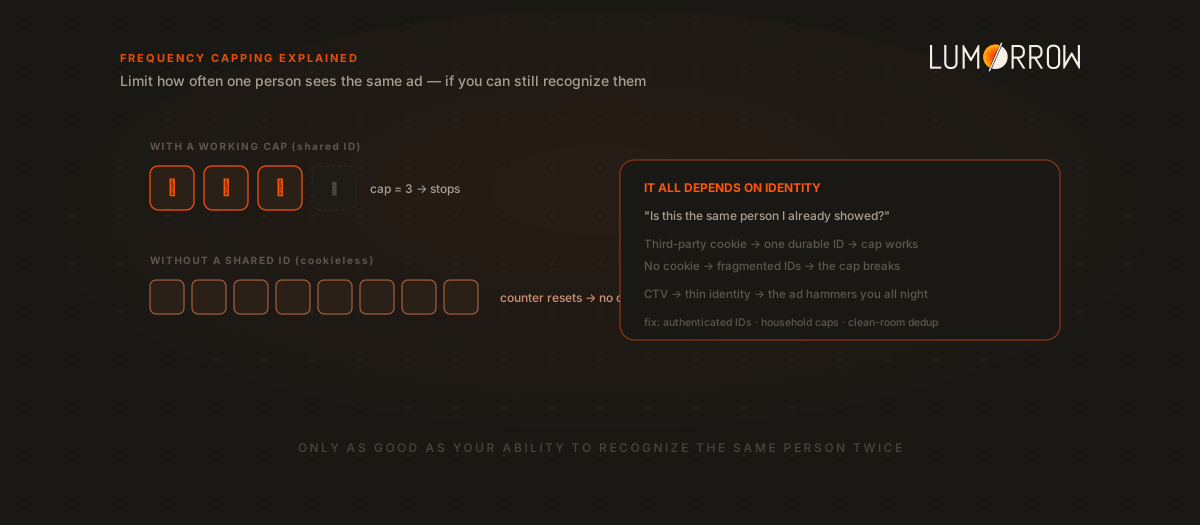
Everyone has experienced broken frequency capping: you look at a product once and its ad chases you across the internet dozens of times a day. That’s not a targeting success — it’s a frequency failure, and it’s getting more common for a specific, structural reason. Understanding frequency capping explains both why the annoyance happens and why it’s surprisingly hard to fix.
Here’s how it works and why it’s breaking.
What frequency capping is
Frequency capping limits how many times a given person is shown the same ad (or campaign) over a defined period — say, no more than three times per day. Its purpose is twofold:
- Protect the advertiser’s budget. Beyond a few exposures, additional impressions on the same person deliver rapidly diminishing returns. Paying to show someone the same ad for the 30th time is wasted money.
- Protect the user experience. Over-exposure moves quickly from “reminder” to “irritation” to active brand damage. An ad that stalks you doesn’t build affinity; it burns it.
Done well, frequency capping is one of the highest-ROI settings in a campaign — it reallocates wasted repeat impressions toward reaching new people.
How it works — and what it depends on
To cap frequency, the system has to answer one question: is this the same person I’ve already shown this ad to? That requires a persistent identifier to recognize the user across impressions, sites, and devices.
Historically, the third-party cookie did that job. Each browser had a stable ID, so a DSP could count “this user has seen the ad twice” and stop at the cap. Frequency capping, in other words, is entirely dependent on identity — no durable ID, no reliable count.
Frequency capping is only as good as your ability to recognize the same person twice. Take away the shared identifier and the counter resets on every site — so the “cap” quietly becomes no cap at all.
Why it’s breaking
Here’s the direct line from the cookieless shift to the ad that won’t leave you alone:
- Without third-party cookies, there’s no shared cross-site ID to count exposures against. Each site or environment sees the user as new, so the frequency counter resets — and the same ad gets served again and again.
- CTV makes it worse. With no browser and thin identity, deduplicating exposure across streaming apps is genuinely hard — which is why the same CTV ad can hammer a viewer within a single evening.
- Fragmentation compounds it. With many competing identity solutions instead of one universal cookie, exposure data is split across systems that don’t share a count.
The result is a paradox: as targeting privacy tightened, the annoyance of over-frequency often got worse, because the same signal loss that limits targeting also breaks the cap.
How it’s being addressed
The fixes track the broader identity story: authenticated and universal IDs re-establish a durable identifier where users log in; publisher-level and household-level capping limit exposure within a known environment even without cross-web ID; and clean-room and platform-level dedup help large platforms cap across their own footprint. None fully restores the universal cross-web counting the cookie enabled — which is why some over-frequency persists.
The takeaway
Frequency capping limits how often a person sees the same ad, protecting both budget and user experience. It depends entirely on being able to recognize the same person across impressions — a job the third-party cookie used to do. As that identifier disappears, exposure counts fragment and the cap breaks, producing the ad that follows you 40 times. Rebuilding it depends on the same identity portfolio — authenticated IDs, household-level controls, and clean-room dedup — that’s replacing the cookie everywhere else.
Lumorrow evaluates the signals on each bid request in real time, pre-auction — part of making every impression count instead of repeating a wasted one. See how the platform works →.