
Identity resolution and universal IDs explained: advertising's cookie replacement
As third-party cookies fade, the industry needs a new way to recognize users across the web. Identity resolution and universal IDs are the answer — or answers, plural. Here's how they work, the main approaches, and why no single one has won.
The third-party cookie did one job that held programmatic together: it gave every browser a recognizable ID, so a user could be identified across sites for targeting, frequency capping, and measurement. As that cookie fades, the industry needs a replacement — and identity resolution and universal IDs are the field of competing answers.
Here’s what they are, the main approaches, and why the market fragmented rather than converging on one winner.
The problem: recognizing users without cookies
Three core ad functions depend on recognizing a user across different sites:
- Targeting — reaching the same person (or audience) wherever they are.
- Frequency capping — not showing the same person the same ad 40 times.
- Measurement — knowing that the person who saw an ad is the one who later converted.
The third-party cookie made all three trivial. Without it, you need another durable identifier — and that’s what identity resolution provides.
What identity resolution is
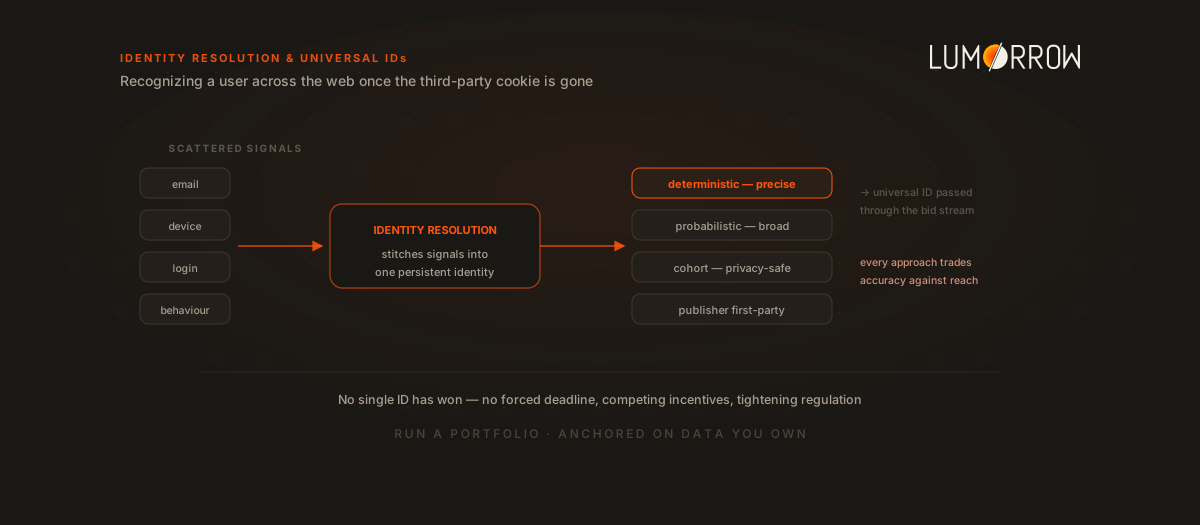
Identity resolution is the process of stitching together the signals a user leaves across devices and sites into a single, persistent identity — so the same person can be recognized without a third-party cookie. A universal ID (or “unified ID”) is the shared identifier that results, designed to be passed through the bid stream so any participant can recognize the user.
The whole point of “universal” is interoperability: instead of every vendor maintaining its own siloed ID, a shared ID lets buyers and sellers speak about the same user.
The main approaches
Identity solutions fall into a few families, each with a different trade-off:
- Authenticated / deterministic IDs. Built from real logged-in signals, usually a hashed email a user provided with consent. The strongest, most accurate approach — but it only works where users authenticate, which is a minority of traffic.
- Probabilistic IDs. Modeled identity inferred from signals like IP, device, and behavior. Broader reach, lower precision, and more privacy scrutiny.
- Cohort-based approaches. Rather than identifying an individual, group users into privacy-safe interest cohorts. Less granular by design, more privacy-preserving.
- Publisher/first-party IDs. A publisher’s own identifier for its authenticated audience, rooted in its first-party data.
Deterministic IDs are precise but only cover logged-in users. Probabilistic IDs reach everyone but with less certainty and more scrutiny. Every approach trades accuracy against reach — which is exactly why no single one has taken over.
Why no single ID has won
With the cookie’s forced-deprecation deadline gone (the cookieless state of play), there’s no single event forcing the market onto one standard. Instead, dozens of IDs coexist, each backed by different players with different incentives. Buyers and publishers end up supporting several at once. The practical result is the portfolio approach: authenticated IDs where you have logins, contextual and cohort methods for the anonymous long tail, and a tolerance for fragmentation.
Two forces keep it fragmented: privacy regulation keeps tightening what’s permissible, and the biggest platforms have their own logged-in identity graphs and little reason to adopt someone else’s.
The takeaway
Identity resolution stitches scattered signals into a persistent identity, and universal IDs are the shared identifiers meant to replace the third-party cookie in the bid stream. There are several competing approaches — deterministic, probabilistic, cohort-based, publisher-first-party — each trading accuracy for reach. No single one has won, so the durable strategy isn’t to bet on one ID but to run a portfolio, anchored on the authenticated first-party data you actually own.
Lumorrow evaluates whatever signals a bid request carries — consented identity, context, and supply quality — in real time, pre-auction, so each impression is valued on what’s actually known about it. See how the platform works →.