
Programmatic audio advertising explained: ads for a screenless medium
Programmatic audio brings automated buying to streaming music, podcasts, and digital radio. Here's how audio ad serving works, why the screenless, one-listener environment is different, and what makes podcast advertising uniquely valuable.
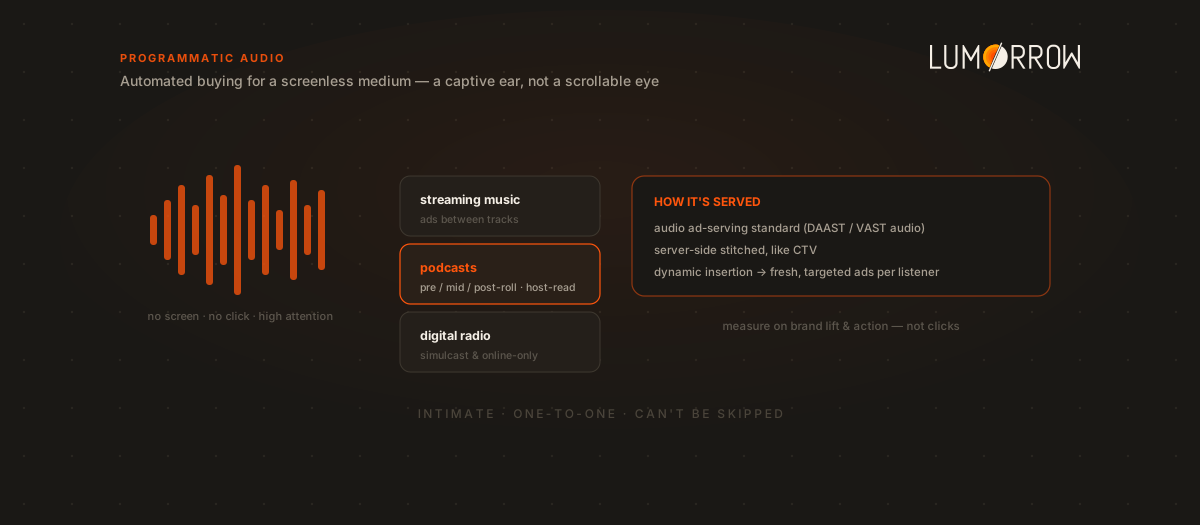
Advertising is overwhelmingly visual — but a growing share of attention happens with no screen at all: streaming music, podcasts, and digital radio, often while commuting, exercising, or working. Programmatic audio brings automated, data-driven buying to that screenless world, and it behaves differently enough from display to be worth understanding on its own terms.
Here’s how programmatic audio works and what makes it distinctive.
What programmatic audio is
Programmatic audio is the automated buying and selling of audio ad inventory — the spots you hear on streaming music services, podcasts, and digital radio — through the same programmatic pipes as display and video. Instead of negotiating radio-style spots by hand, buyers use a DSP to target and bid on individual audio impressions in real time.
The inventory spans three main environments:
- Streaming music — ad-supported tiers of music services, where audio ads play between tracks.
- Podcasts — pre-roll, mid-roll, and post-roll spots within episodes.
- Digital radio — streaming simulcasts and online-only stations.
Why the audio environment is different
Audio isn’t just “display without pictures” — the medium changes the rules:
- Screenless and often eyes-free. The listener is usually doing something else — driving, running, cooking. That means high attention to the audio but no click to measure, so success is judged on brand lift, recall, and downstream action rather than clicks.
- One-to-one and intimate. Audio is typically consumed alone, on headphones, which gives it an unusually personal, high-engagement quality — especially podcasts, where listeners trust the host.
- Sequential, not spatial. You can’t ignore an audio ad the way your eye skips a banner; it plays in the flow. That makes frequency capping and creative fatigue especially important.
Audio has no screen and no click — but often more attention than the media that do. You’re buying a captive ear, not a scrollable eye, which changes what “good” looks like and how you measure it.
How audio ad serving works
The flow mirrors video/VAST with an audio-specific standard: the industry uses DAAST (and increasingly VAST’s audio support) as the template that lets any audio player request, play, and track an ad from any ad server. Much streaming audio is delivered via server-side insertion — stitched into the stream like CTV — and podcasts commonly use dynamic ad insertion (DAI), which lets a single episode serve different, freshly-targeted ads to different listeners (and even into old back-catalog episodes) rather than baking one ad in forever.
What makes podcasts special
Podcast advertising deserves its own note. Beyond dynamically-inserted spots, it has the host-read endorsement — the host personally voicing the ad — which carries trust and attention that automated formats struggle to match. The trade-off is measurement: podcast attribution has historically been fuzzy, which is why the medium leans on promo codes, vanity URLs, and increasingly pixel- and survey-based measurement to prove it works.
The takeaway
Programmatic audio brings automated buying to streaming music, podcasts, and digital radio — a screenless, often eyes-free, one-to-one medium where attention is high but there’s no click to count. It runs on audio ad-serving standards and dynamic insertion that tailor spots per listener, with podcasts adding the uniquely trusted host-read format. Buy it for attention and brand impact rather than clicks, mind frequency in a medium you can’t skip, and measure with the outcome-based tools the screenless environment requires.
Lumorrow’s real-time, pre-auction intelligence evaluates supply quality across channels — helping every impression, audio included, be valued on what it’s actually worth. See how the platform works →.