
Server-side ad insertion (SSAI) explained: how streaming ads feel like TV
SSAI stitches ads directly into a video stream on the server, so they play seamlessly like broadcast TV. Here's how server-side ad insertion works, why it's essential for CTV, and the measurement and fraud trade-offs it creates.
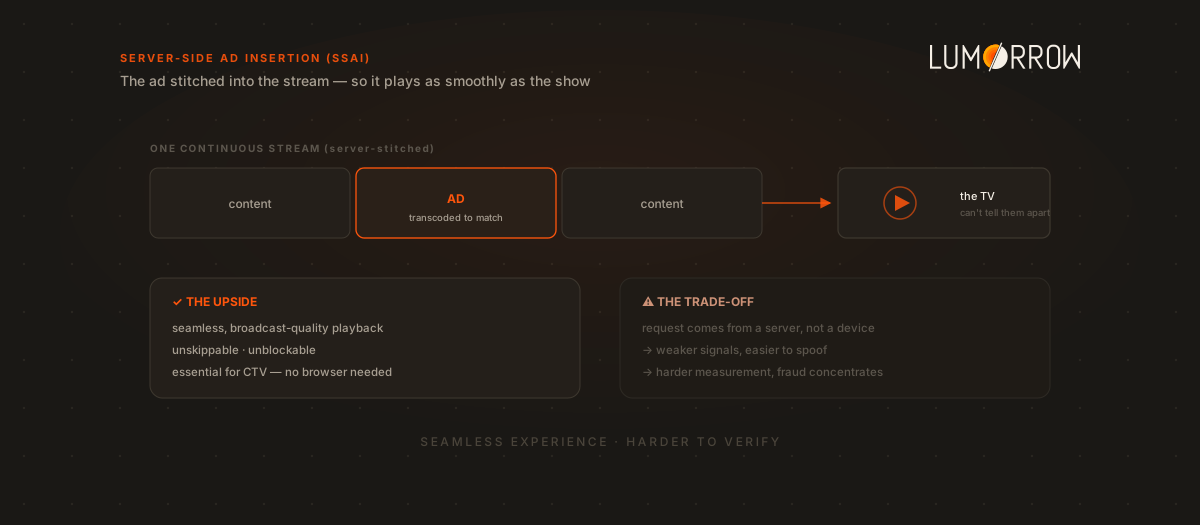
The reason ads on premium streaming services play as smoothly as the show — no buffering, no obvious “ad break” stutter — is a technology called SSAI. It’s the backbone of CTV monetization, and understanding it explains both why streaming ads feel like broadcast TV and why CTV measurement and fraud are so hard.
Here’s how server-side ad insertion works and the trade-offs it makes.
Client-side vs. server-side insertion
There are two ways to get an ad into a video:
- Client-side ad insertion (CSAI) — the video player itself pauses the content, calls out for an ad, receives it, plays it, then resumes. It’s flexible and interactive, but the “handoff” between content and ad can buffer or glitch, and ad blockers can intercept the call.
- Server-side ad insertion (SSAI) — a server stitches the ad directly into the video stream before it reaches the player, so content and ads arrive as one continuous stream. The player just plays what it’s given; it can’t tell where the show ends and the ad begins.
SSAI is also called “ad stitching” or “server-side beaconing,” and it’s what makes streaming ads feel seamless.
How SSAI works
The mechanics, simplified:
- As a viewer streams content, the server assembling the video reaches an ad break.
- The server makes the ad request (to an SSP/exchange) on the viewer’s behalf, passing along what it knows about the stream and device.
- The winning ad is transcoded to match the content’s format and resolution, then spliced into the stream so it plays at the same quality with no interruption.
- Tracking events fire from the server as the stitched ad plays.
The result: a broadcast-quality experience, unskippable and unblockable, delivered over the internet.
SSAI makes the ad indistinguishable from the content — same stream, same quality, no buffering. That seamlessness is exactly why premium streaming uses it, and exactly why it’s harder to verify.
Why SSAI is essential for CTV
CTV practically requires SSAI. There’s no browser on a TV to run client-side ad calls, streaming demands smooth playback across countless device types, and premium content can’t tolerate a buffering ad break. SSAI solves all of that by doing the work server-side and handing the device a single clean stream. It’s why the technology is nearly universal in connected TV.
The trade-offs: measurement and fraud
Seamlessness comes at a cost, and it’s the root of CTV’s hardest problems:
- Weaker signals. Because the ad request comes from a server rather than an identifiable device in a browser, the signals that prove an impression is real are thinner and easier to fake. This is why CTV is the front line for ad fraud — the same stitching that delivers clean playback also obscures where an impression truly originated, enabling server-side spoofing schemes.
- Harder measurement. Viewability and verification code that assumes a browser environment doesn’t map cleanly onto stitched streams, which is part of why CTV measurement remains a work in progress (and why standards like OMID exist).
- Interactivity limits. Executable interactive formats built for the browser don’t work in a stitched stream, which is why the industry moved to CTV-friendly successors.
None of this makes SSAI bad — it’s necessary. It just means CTV supply quality has to be verified with approaches built for a server-stitched world, not inherited from display.
The takeaway
Server-side ad insertion stitches ads directly into a video stream on the server, so they play as seamlessly as the content — no buffering, unskippable, unblockable. It’s essential for CTV because there’s no browser to run client-side ad calls and premium streaming demands smooth playback. The trade-off is that server-side delivery weakens the signals used to verify impressions, which is exactly why CTV measurement is immature and fraud concentrates there. Great experience, harder trust — and that trust gap is the problem worth solving.
Lumorrow evaluates CTV and OTT supply quality and validity in real time, pre-auction — built for a server-stitched world where the old browser signals don’t apply. Explore CTV & OTT solutions → or see how the platform works →.