
VAST and VPAID explained: how video ads actually get served
Video advertising runs on standards that let any player talk to any ad server. VAST is the core template; VPAID added interactivity (and problems); VMAP schedules breaks; SIMID and OMID are the modern successors. Here's how video ad serving works.
Video advertising has its own layer of standards, and they trip people up because they’re acronyms describing plumbing most people never see. But if you work with video or CTV, understanding VAST and its relatives explains a lot about why video ads behave — and misbehave — the way they do.
Here’s how video ad serving actually works.
The problem these standards solve
A video player and an ad server are usually built by different companies. For a player to request an ad, receive it, play it, and report what happened, the two need a shared format. Without a standard, every player would need a custom integration with every ad server — the same interoperability problem OpenRTB solved for bidding. Video’s answer is the VAST family of standards, stewarded by IAB Tech Lab.
VAST — the core template
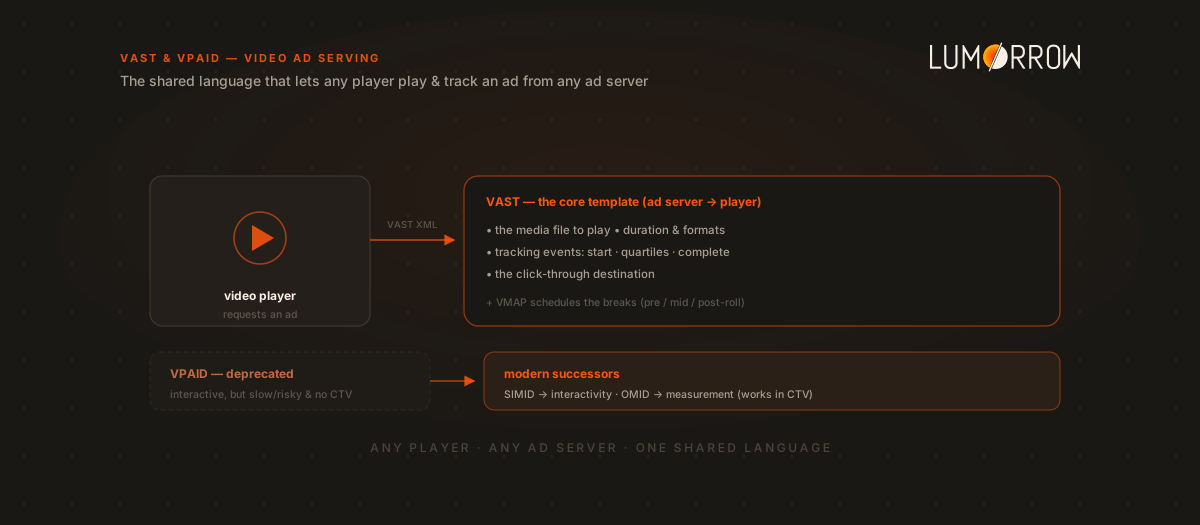
VAST (Video Ad Serving Template) is the foundational standard. It’s an XML response an ad server returns to a video player that tells the player everything it needs to run the ad:
- where the video file is (the media file to play),
- how long it is and what formats are available,
- which tracking events to fire — start, first quartile, midpoint, third quartile, complete, click — so delivery can be measured,
- where the click should go.
When a player requests a video ad and gets a VAST response, it knows how to play that ad and report on it, regardless of who served it. VAST is the backbone of essentially all video and CTV ad serving.
VAST is a set of instructions from the ad server to the player: here’s the video, here’s how long, here’s what to track, here’s where the click goes. Any player, any ad server, one shared language.
VPAID — interactivity, and its problems
VPAID (Video Player-Ad Interface Definition) extended VAST to allow interactive and executable video ads — units that could run their own code inside the player for rich interactivity and richer measurement.
The power came with real problems: VPAID ran vendor code inside the player, which hurt performance, created security and fraud risks, and behaved inconsistently — and it simply doesn’t work in server-stitched CTV/SSAI environments, where there’s no browser to execute it. As a result, VPAID has been deprecated in favor of safer, purpose-built successors.
The modern successors
The industry split VPAID’s two jobs — interactivity and measurement — into cleaner standards:
- SIMID (Secure Interactive Media Interface Definition) handles interactivity by separating the interactive layer from the video playback, so it’s safer and works across environments including CTV.
- OMID (Open Measurement Interface Definition) handles measurement and verification through the Open Measurement SDK, giving independent viewability and validity measurement without running risky ad code in the player.
- VMAP (Video Multiple Ad Playlist) is a companion standard that schedules where ad breaks fall in a video — pre-roll, mid-roll, post-roll — so the player knows when to request ads.
Together, modern video serving is usually VAST + VMAP for delivery and scheduling, with OMID for measurement and SIMID for interactivity — VPAID retired.
Why it matters
These standards explain a lot of real-world video behavior: why an ad tracked to “completion,” why interactive units work in some environments and not others, and why CTV measurement is genuinely hard (server-side stitching limits what the old browser-based approaches could do). Knowing which standard is in play tells you what’s measurable and what’s possible for a given placement.
The takeaway
VAST is the core template that lets any video player request, play, and track an ad from any ad server. VPAID added interactivity but brought performance, security, and CTV-compatibility problems, so it’s been deprecated in favor of SIMID (interactivity) and OMID (measurement), with VMAP scheduling the breaks. If you work in video or CTV, these standards are the grammar of how ads get served — and understanding them demystifies a lot of otherwise-confusing behavior.
Lumorrow evaluates video and CTV supply quality in real time, pre-auction — before the VAST response is ever served. Explore CTV & OTT solutions → or see how the platform works →.