
Incrementality explained: did the ad actually cause the sale?
Incrementality measures the conversions an ad genuinely caused — not the ones that would have happened anyway. Here's what incrementality and lift mean, how holdout tests work, and why it's the honest answer to attribution's biggest flaw.
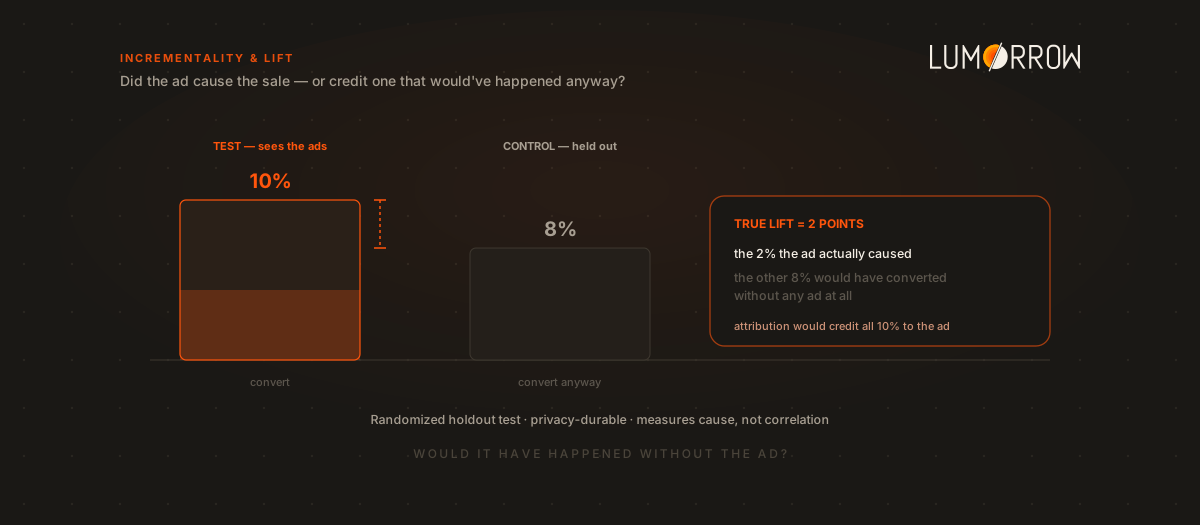
Here’s an uncomfortable question every advertiser should ask: of all the conversions your ads “drove,” how many would have happened anyway? If someone was already going to buy, and they clicked your retargeting ad on the way to checkout, your report credits the ad — but the ad changed nothing. Incrementality is the discipline of measuring what your advertising actually caused, and it’s the honest counterweight to attribution’s biggest blind spot.
Here’s what incrementality is and how it’s measured.
The problem incrementality solves
Standard attribution credits ads for conversions that touched them. But correlation isn’t causation. Some — often many — of those conversions would have happened without the ad:
- Someone who already loves your brand searches for it, clicks your ad, and buys. Attribution credits the ad; the sale was never in doubt.
- Retargeting is the classic offender — it targets people who already showed intent, so it naturally “wins” credit for conversions that were highly likely regardless.
The result: attribution systematically over-credits advertising, and the most over-credited tactics can look like the best performers precisely because they target people closest to converting. Incrementality asks the harder, truer question: what happened because of the ad that wouldn’t have happened otherwise?
What incrementality (lift) measures
Incrementality measures the additional conversions caused by advertising — the ones that would not have occurred without it. That additional amount is the lift.
The logic is borrowed from science: compare a group exposed to the ad against a comparable group that wasn’t, and the difference is the true effect.
- Test group: sees the ads.
- Control (holdout) group: comparable people deliberately not shown the ads.
- Lift = conversions in test − conversions in control.
If the test group converts at 10% and the holdout at 8%, the incremental lift is 2 percentage points — that’s what the advertising actually added. The other 8% would have converted anyway.
Attribution asks “which ad touched this conversion?” Incrementality asks “would this conversion have happened without any ad at all?” Only the second question tells you whether your budget did anything.
How it’s measured
The gold standard is a randomized controlled experiment — a holdout test:
- Randomly split a comparable audience into test (exposed) and control (held out).
- Run the campaign to the test group only.
- Measure conversions in both groups over the same window.
- The difference is incremental lift; the ratio gives incremental ROAS.
Variations include geo-based tests (some regions get the campaign, comparable ones don’t) and ghost/PSA holdouts (the control group is served an unrelated ad so exposure conditions match). The common thread is a genuine, comparable control group — without one, you’re measuring correlation, not cause.
Where it fits
Incrementality complements rather than replaces other measurement. Attribution is fast and granular but causally naive; media mix modeling estimates contribution across channels at a high level; incrementality experiments give the cleanest causal read on a specific tactic or channel. Sophisticated advertisers triangulate all three. Incrementality is also increasingly important because it’s privacy-durable — a well-designed holdout test measures cause without needing to track individuals across the web.
The takeaway
Incrementality measures the conversions your advertising genuinely caused — the lift over what would have happened anyway — by comparing an exposed test group against a held-out control. It’s the honest correction to attribution, which systematically over-credits ads (especially retargeting) for conversions that were already going to happen. Run holdout tests on your biggest bets, use lift rather than last-click to judge them, and you’ll fund the advertising that actually moves the needle instead of the advertising that merely takes credit.
Lumorrow’s real-time, pre-auction intelligence helps ensure the impressions you measure are valid and quality in the first place — so incrementality tests run on real inventory. See how the platform works →.