
Video ad metrics explained: VCR, CPCV, quartiles and completion
Video advertising has its own measurement vocabulary — completion rate, quartile reporting, cost per completed view. Here's what each metric means, how they're captured, and why completion isn't the same as attention.
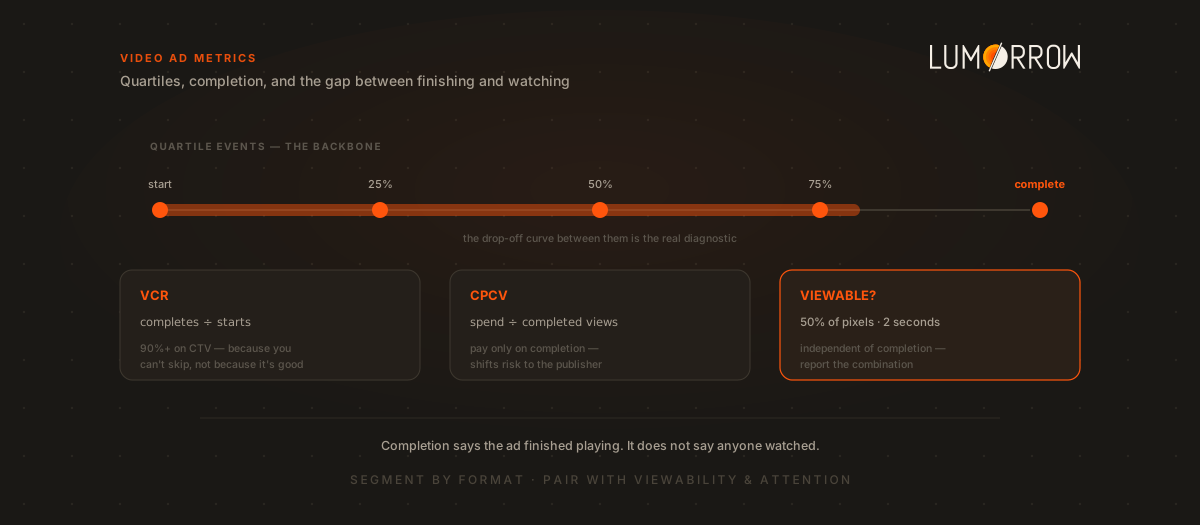
Display advertising asks a fairly simple question: was the ad on screen? Video asks a richer one, because a video ad unfolds over time — someone can see the first two seconds and leave, or watch all thirty. That temporal dimension gives video its own metrics vocabulary, and it’s worth knowing precisely, because the terms are frequently misused.
Here’s what the main video metrics mean.
Quartile reporting: the backbone
Video measurement is built on quartile events fired by the player as the ad plays — the tracking hooks that VAST defines:
- Start (impression begins)
- First quartile — 25% viewed
- Midpoint — 50% viewed
- Third quartile — 75% viewed
- Complete — 100% viewed
Everything else is derived from these. The drop-off curve between them is genuinely useful diagnostic information: heavy loss before the first quartile usually signals a weak opening or an unwanted interruption, while a healthy curve that falls off at the third quartile suggests a length problem rather than a creative one.
VCR — video completion rate
VCR (video completion rate) is the percentage of started video ads that played all the way to the end:
VCR = (completes ÷ starts) × 100
It’s the headline video engagement metric. Context matters enormously when reading it: skippable formats naturally show much lower VCR (viewers can leave), while non-skippable and especially CTV inventory routinely posts very high VCR — often above 90% — simply because the viewer can’t skip and the TV keeps playing.
That’s the trap: a 95% VCR on CTV isn’t evidence that your creative was compelling. It’s evidence the format didn’t allow leaving.
CPCV — cost per completed view
CPCV (cost per completed view) is what the advertiser paid for each completed view:
CPCV = total spend ÷ completed views
It’s a pricing model as well as a metric — buying on CPCV means paying only when the ad plays to the end, shifting delivery risk toward the publisher (the same risk-ladder logic as CPC and CPA). Useful for guaranteeing full-message delivery; less meaningful in unskippable environments where completion is close to automatic.
Related: CPV (cost per view), where a “view” is a threshold shorter than completion — definitions vary by platform, so always check what counts.
Completion tells you the ad finished playing. It does not tell you anyone watched. In unskippable environments those are very different claims — which is exactly why attention measurement exists.
Viewability in video
Video has its own viewability bar: the MRC standard requires 50% of pixels in view for at least two continuous seconds (versus one second for display). Note that viewability and completion are independent — an ad can complete while scrolled out of view, or be perfectly viewable and abandoned at 30%. Serious reporting pairs them; completed and viewable is the meaningful combination.
Audibility matters too: much video plays muted by default, so a “completed view” with no sound is a different creative proposition than one with audio on.
Reading these metrics honestly
- Always segment by format and environment. Blending skippable, non-skippable, in-stream, out-stream, and CTV into one VCR produces a number that describes nothing — the same averaging problem as blended eCPM.
- Don’t treat high VCR as success in unskippable inventory. It’s a property of the format.
- Pair completion with viewability and audibility.
- Use attention metrics for the real question. Attention models estimate whether a human actually engaged, which completion cannot.
- Validate with incrementality. Ultimately, whether the video drove an outcome beats any playback statistic.
The takeaway
Video metrics are built on quartile events (start, 25%, 50%, 75%, complete), from which VCR (completion rate) and CPCV (cost per completed view) are derived. They’re valuable for diagnosing creative and length, but easy to over-read — high VCR in non-skippable and CTV inventory reflects the format, not the creative. Segment by environment, pair completion with viewability and audibility, and lean on attention and incrementality for the question these metrics can’t answer: did anyone actually watch, and did it work?
Lumorrow evaluates video and CTV supply quality and validity in real time, pre-auction — so the impressions behind your completion numbers are real. Explore CTV & OTT solutions → or see how the platform works →.