
Consent management explained: CMPs, GDPR, CCPA, and the TCF
Privacy law made consent a precondition for most ad targeting. Consent management platforms capture and pass that consent through the ad stream. Here's how CMPs, the IAB TCF, GDPR, and CCPA fit together — and why sloppy consent shrinks your addressable audience.
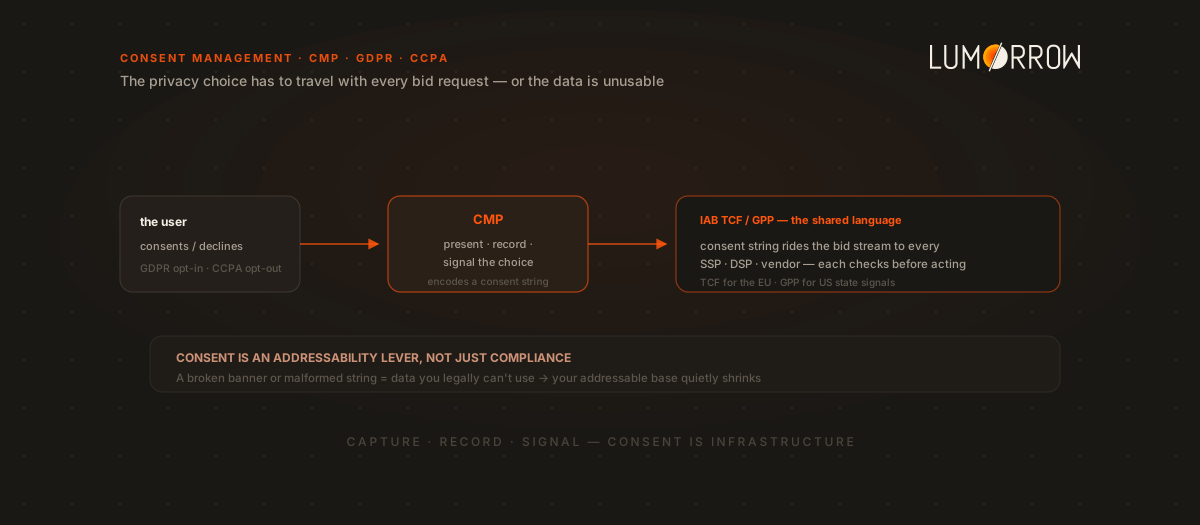
Every cookie banner you’ve ever clicked is the visible tip of a large, consequential system. Privacy regulation turned user consent from an afterthought into a precondition for much of digital advertising — and a whole layer of technology exists to capture that consent and carry it through the ad stream. Get it right and your data is usable; get it wrong and your addressable audience quietly shrinks.
Here’s how consent management works and why it’s now infrastructure, not compliance box-ticking.
Why consent became mandatory
Two landmark regulations reset the rules:
- GDPR (the EU’s General Data Protection Regulation) requires, for much personal-data processing in advertising, a lawful basis — often the user’s freely given, informed consent (opt-in). No valid basis, no lawful processing.
- CCPA/CPRA (California’s privacy laws) take an opt-out approach — users have the right to opt out of the “sale” or “sharing” of their personal information, including much ad targeting.
The models differ (opt-in vs. opt-out), but the effect is the same: a user’s privacy choice now governs whether and how their data can be used for advertising. And these are just two of a fast-growing list of privacy regimes worldwide.
What a consent management platform does
A consent management platform (CMP) is the technology that captures a user’s privacy choices and makes them available to everyone downstream. Its jobs:
- Present the choice — the banner or preference center where the user consents, declines, or sets granular preferences.
- Record it — store an auditable record of what the user agreed to and when.
- Signal it — encode the choice into a standardized string and pass it through the ad tech chain, so every SSP, DSP, and vendor knows what’s permitted for this user.
That last step is the critical one: consent is worthless to the ecosystem if it can’t travel with the bid request.
The TCF — a shared consent language
For consent to pass cleanly between thousands of independent companies, they need a shared format — the same interoperability problem OpenRTB solved for bidding. The IAB Transparency & Consent Framework (TCF) is that standard for the European market: it defines how a CMP encodes user choices (which purposes, which vendors) into a consent string that flows through the bid stream, so each participant can check permission before acting.
There’s an equivalent for US state privacy signals (the Global Privacy Platform / GPP), consolidating the growing patchwork of state regimes into one transport.
Consent isn’t just a banner — it’s a signal that has to travel with every bid request. A CMP captures the choice; a framework like the TCF is the shared language that carries it to every downstream vendor.
Why sloppy consent shrinks your audience
Here’s the part publishers underestimate: consent is an addressability lever, not just a legal requirement. First-party data, identity, and targeting are only usable on users whose consent actually permits it. A confusing banner, a broken consent string, or a vendor that isn’t properly authorized means data that’s legally unusable — quietly cutting your addressable base. In a cookieless world where every consented signal is precious, clean consent management directly protects revenue. It’s infrastructure, not paperwork.
The takeaway
Consent management is how the privacy choices demanded by GDPR, CCPA, and a widening set of laws get captured and carried through advertising. A CMP presents the choice, records it, and signals it downstream via shared frameworks like the IAB TCF (and GPP in the US). Treat it as core infrastructure: honored, well-formed consent is what makes your first-party data and targeting usable, while sloppy consent silently shrinks the audience you can actually reach and monetize.
Lumorrow evaluates each bid request on the consented signals it carries, in real time, pre-auction — valuing impressions on what’s actually permitted and known. See how the platform works →.