
Auction timeouts and latency explained: the stopwatch every impression runs against
Every programmatic auction runs against a deadline. Set the timeout too short and you lose bids; too long and you lose the user. Here's how auction timeouts work, where latency comes from, and how to find the right setting.
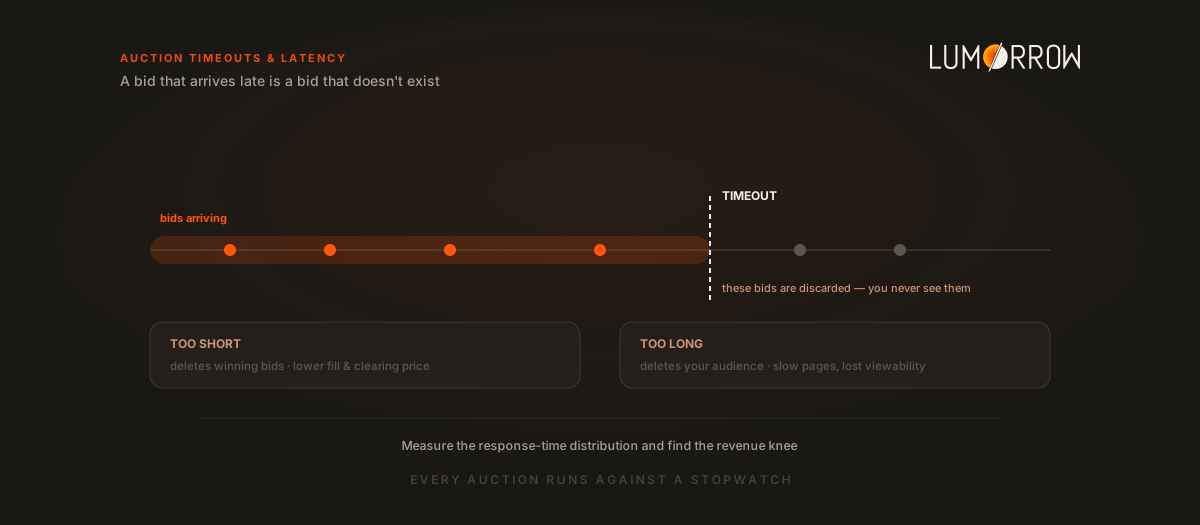
Programmatic has a constraint most explanations gloss over: it all has to finish before the page does. Every auction runs against a stopwatch, and the setting that governs it — the timeout — is one of the most consequential and least examined numbers in publisher monetization. Too short and you throw away real money. Too long and you lose the reader entirely.
Here’s how timeouts and latency actually work.
What a timeout is
A timeout is the maximum time an auction will wait for bids before proceeding with whatever it has. When a page loads and the header bidding wrapper requests bids from a dozen demand partners, it doesn’t wait indefinitely — it waits, say, 1,000 milliseconds, takes every bid that arrived, and discards the rest.
That’s the trade in one sentence: a bid that arrives late is a bid that doesn’t exist.
Where the latency comes from
The time budget gets consumed in several places:
- Network round trips — the request travels to each demand partner and back. Physical distance and connection quality matter, and mobile networks are far slower than desktop broadband.
- Bidder response time — each DSP must evaluate the impression and compute a bid. Some are consistently fast; some are consistently slow.
- The slowest partner sets the pace. In a parallel auction you’re waiting on the last responder, so one chronically slow bidder can drag the whole auction to the timeout.
- Client-side processing — running the auction in the browser costs CPU, which is scarce on mid-range phones.
- Chained hops — every extra intermediary in the supply path adds another leg of latency.
The cost of getting it wrong
Both directions are expensive, which is what makes this hard:
Timeout too short. Slower bidders get cut off before responding. Since the highest bid can come from any partner, you’re randomly discarding potentially winning bids — directly lowering competition, clearing prices, and fill rate. You never see this loss in a report; the bid simply never existed.
Timeout too long. The user waits. Ads render late or after scroll — hurting viewability and attention — and page speed degrades, which harms user experience, SEO, and bounce rate. Push it far enough and users leave before the ad ever renders, or reach for an ad blocker.
A short timeout quietly deletes your best bids. A long one quietly deletes your audience. The correct setting is an empirical question, not a default you inherit.
Client-side vs. server-side
Where the auction runs changes the calculus. Client-side auctions run in the browser, so each partner’s latency is paid on the user’s device and connection — practically capping how many partners you can call. Server-side auctions move the work to a server with fast, stable connections, so far more partners can be called within the same budget. The trade-off is some signal loss, which is why hybrid setups are common.
Finding the right timeout
This should be measured, not guessed:
- Look at your bidder response-time distribution. For each partner, at what point have most of their bids arrived? Extending past that point buys you almost nothing.
- Find the diminishing-returns knee. Plot revenue against timeout. Typically it rises steeply, then flattens — the flattening point is your setting; beyond it you’re paying latency for nothing.
- Segment by device and connection. Mobile deserves different treatment from desktop. One global number is a compromise that’s wrong for both.
- Manage slow partners directly. If one bidder consistently misses, the fix is to address or drop that partner rather than penalize the whole auction.
- Retest regularly. Partner performance drifts, so a timeout tuned last year is probably wrong now.
The bigger point
The timeout is a symptom of a deeper truth: programmatic is a real-time system with a hard deadline, and every millisecond spent is spent on something. Milliseconds burned on redundant duplicate supply paths or on partners who never win are milliseconds unavailable to bidders who would have paid. That’s why traffic shaping and pre-auction decisioning matter — deciding who’s even worth asking is a better lever than simply waiting longer.
The takeaway
An auction timeout caps how long the auction waits for bids, and it’s a genuine trade-off: too short discards winning bids you’ll never see, too long degrades page speed, viewability, and the user experience. Latency comes from network trips, slow bidders, client-side processing, and long supply chains. Treat the setting as an empirical question — measure response-time distributions, find the revenue knee, segment by device, and fix slow partners rather than waiting for them.
Lumorrow makes the pre-auction decision — which requests are worth transacting on, and at what floor — in real time, so the time budget goes to bidders who’ll actually pay. See how the platform works →.