
Traffic shaping explained: sending fewer bid requests, and better ones
Most bid requests never win anything — they just cost compute, latency, and carbon. Traffic shaping is how exchanges decide which requests are worth forwarding. Here's how it works and why it's become essential infrastructure.
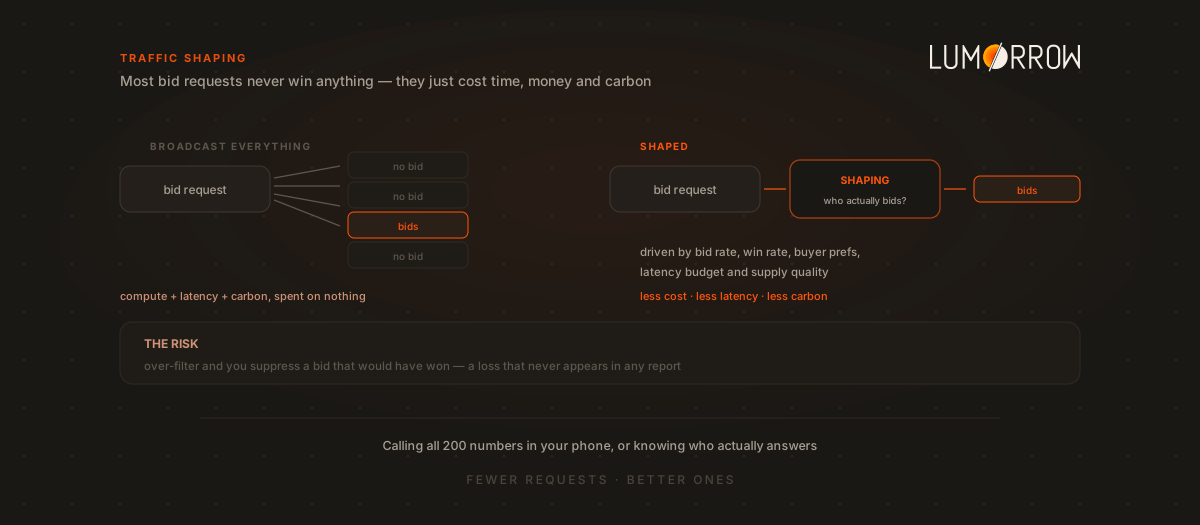
Here’s an uncomfortable statistic about how programmatic actually operates: the overwhelming majority of bid requests sent to any given buyer result in no bid at all. The request was assembled, transmitted, evaluated, and discarded — consuming bandwidth, compute, and milliseconds on both sides for nothing. Multiply by trillions of daily impressions and you have one of the largest sources of waste in the industry.
Traffic shaping is the discipline of not doing that. Here’s how it works.
What traffic shaping is
Traffic shaping (sometimes called bid request filtering or throttling) is an exchange or SSP intelligently deciding which bid requests to send to which buyers, rather than broadcasting every request to everyone.
The old default was indiscriminate: a request arrives, fan it out to every connected DSP, see who bids. Simple, and enormously wasteful — because the exchange already has strong evidence about which buyers actually bid on which kinds of inventory. Traffic shaping uses that evidence: if a DSP has never bid on this geo, format, or publisher in millions of prior opportunities, sending it the request again is predictable waste.
Broadcasting every request to every buyer is like calling all 200 numbers in your phone to ask one question. Traffic shaping is knowing who actually answers.
How it works
Shaping decisions are driven by historical patterns:
- Bid rate by segment. Does this buyer bid on this publisher, format, geo, device, and daypart? Consistently low rates mean low value in asking.
- Win rate and clearing price. Buyers who bid but never win at your floors add competition in theory and noise in practice.
- Buyer-declared preferences. Many DSPs signal what they don’t want; shaping honours that rather than ignoring it.
- Latency budget. With a hard timeout, the time spent waiting on non-bidders is time taken from bidders who would pay.
- Supply quality. Requests from questionable supply paths or likely invalid traffic shouldn’t be forwarded at all.
The output is a per-request routing decision made before the fan-out: send this to these buyers, skip the rest.
Why it matters
Shaping delivers several benefits at once, which is why it went from optimization to infrastructure:
- Cost. Processing and transmitting bid requests is the core operating expense of an exchange and a DSP. Cutting requests that never convert cuts real infrastructure cost on both sides.
- Latency. Fewer, better-targeted calls fit the timeout budget more comfortably — improving the odds real bids arrive in time.
- Buyer relationships. DSPs increasingly judge exchanges on request quality, not volume. Flooding a buyer with un-biddable requests degrades their economics and can get you deprioritized.
- Sustainability. Every avoided request is avoided computation. Shaping is one of the most direct levers on ad tech’s carbon footprint — and it costs less at the same time.
The risk of shaping too aggressively
The obvious danger: filter too hard and you suppress a bid that would have won. Because shaping is prediction, an over-tuned model quietly caps competition and depresses yield — and, like a too-short timeout, the loss is invisible in reporting because the bid never existed.
There’s a transparency dimension too. If an exchange silently withholds inventory from some buyers, both publishers and buyers deserve to understand that shaping happens and on what basis — the same accountability logic behind supply-chain transparency. Good shaping is continuously evaluated (with exploration held back to keep testing suppressed paths), not set once and trusted forever.
The takeaway
Traffic shaping is the practice of deciding which bid requests are worth sending to which buyers, instead of broadcasting everything to everyone. Using historical bid and win patterns, buyer preferences, latency budgets, and supply quality, it cuts infrastructure cost, protects the auction’s time budget, improves buyer relationships, and lowers carbon — the same “less waste = less cost” pattern that runs through supply path optimization. The discipline is in not over-filtering: shaping is a prediction, and a suppressed winning bid is a loss you’ll never see in a report.
Lumorrow makes the pre-auction call — which requests are worth transacting on, for whom, and at what floor — in real time, on every request. See how the platform works → or explore it for demand partners →.