
Prebid explained: the open-source backbone of header bidding
Prebid is the open-source framework that most header bidding runs on. Here's what Prebid.js, Prebid Server, and Prebid Mobile do, how the wrapper orchestrates the auction, and why an open standard came to dominate publisher monetization.
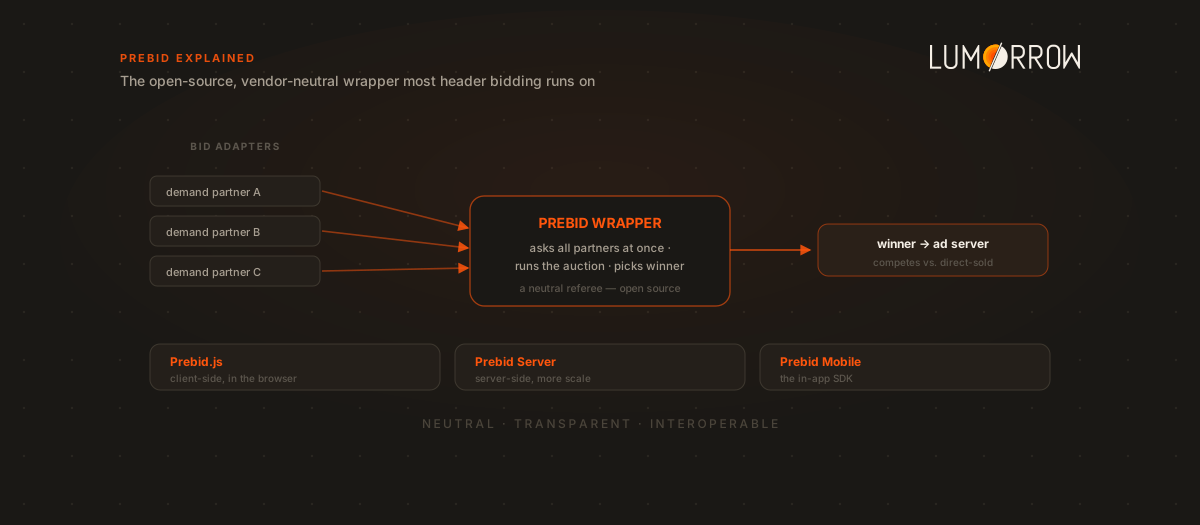
If header bidding is how publishers run a real auction across many demand sources, Prebid is what most of them actually run it with. It’s the open-source plumbing beneath a huge share of publisher monetization — and understanding it demystifies how header bidding works in practice.
Here’s what Prebid is and why an open-source project became the industry standard.
What Prebid is
Prebid is a free, open-source framework for running header-bidding auctions. Rather than every publisher building the complex machinery to solicit and compare bids from many demand partners, Prebid provides a shared, community-maintained wrapper that does it for them. It’s governed by a nonprofit (Prebid.org) with contributions from across the industry, which is exactly why it became a neutral standard rather than any single vendor’s tool.
There are three main pieces, one per environment:
- Prebid.js — the JavaScript library that runs client-side header bidding in the browser.
- Prebid Server — the server-side version, which moves the auction off the page and onto a server for speed and scale.
- Prebid Mobile — the SDK for header bidding inside mobile apps.
What the wrapper actually does
The “wrapper” is the orchestrator. When a page (or app) loads, Prebid handles the whole header-bidding sequence:
- Sends bid requests to all the publisher’s configured demand partners (called bid adapters) at once.
- Collects the bids as they come back, within a set timeout.
- Runs the auction to find the highest bid.
- Passes the winner to the ad server as a key-value, so it can compete against direct-sold deals and any other demand.
- Manages the mechanics — timeouts, floor pricing, consent signals (CMP/TCF), and identity modules.
Each demand partner plugs in through a standardized bid adapter, so a publisher can add or remove partners without custom integration work. That modularity is a big part of Prebid’s appeal.
Prebid is the referee of the header-bidding auction: it asks every demand partner at once, collects their bids under a stopwatch, picks the winner, and hands it to the ad server — all through one shared, open framework.
Why open source won
Header bidding could have fragmented into a dozen proprietary wrappers, each locking publishers in. Instead, an open-source project became dominant, for good reasons:
- Neutrality. A publisher running Prebid isn’t beholden to a single vendor whose incentive is to favor its own demand. The wrapper is a neutral auctioneer.
- Transparency. The code is open, so publishers can see exactly how the auction runs — no hidden favoritism, which matters given the bid-shading and take-rate dynamics of first-price auctions.
- Interoperability. Standardized adapters mean any demand partner can integrate once and reach every Prebid publisher — the same network-effect logic behind OpenRTB.
Client-side vs. server-side in Prebid
Prebid supports the same trade-off we covered in the header bidding guide: Prebid.js (client-side) gives full user signal and transparency but is limited by browser performance; Prebid Server (server-side) supports far more demand partners with less page load, at some cost to signal fidelity. Most sophisticated setups run a hybrid — top partners client-side, the long tail server-side.
The takeaway
Prebid is the open-source framework that powers most header bidding — a neutral wrapper that solicits bids from many demand partners at once, runs the auction, and hands the winner to the ad server. Its three flavors (Prebid.js, Prebid Server, Prebid Mobile) cover web, server, and app. It won because an open, transparent, vendor-neutral standard is exactly what publishers need to run a fair auction — and it’s the practical foundation beneath the header-bidding concepts everyone talks about.
Lumorrow adds real-time, pre-auction intelligence on top of the header-bidding stack — setting floors and evaluating quality per impression, before the wrapper’s auction even runs. See how the platform works → or explore it as a publisher →.