
In-app advertising explained: how mobile app monetization works
In-app advertising monetizes mobile apps through an SDK-and-mediation stack that's distinct from the web. Here's how mobile ad formats, mediation, and waterfalls vs. in-app bidding work — and why app identity and measurement differ from the browser.
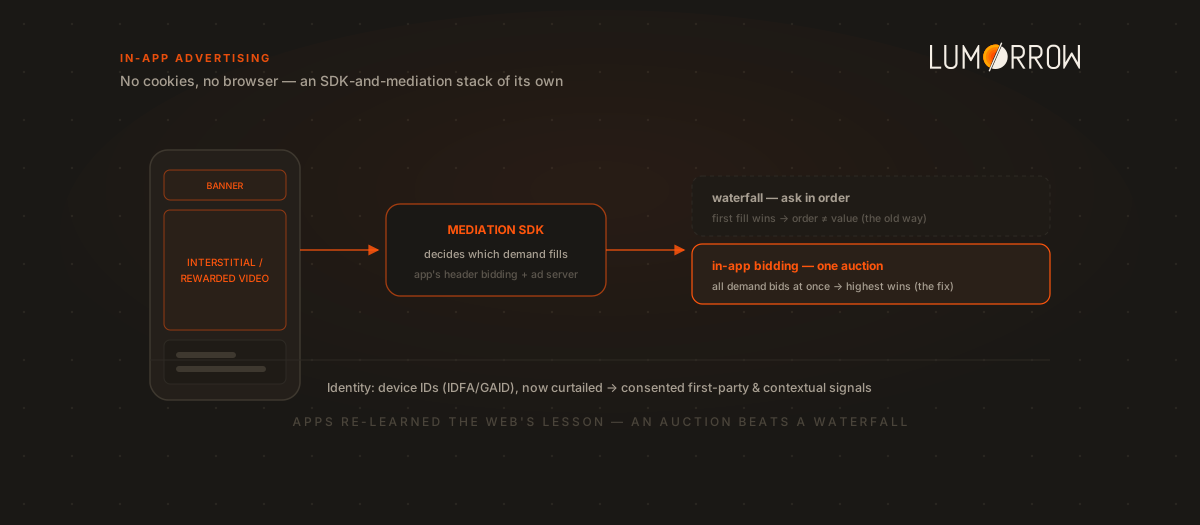
Most of the time people spend on phones is in apps, not browsers — and apps monetize through a stack that’s meaningfully different from the web. If you only know web advertising, in-app has its own formats, its own plumbing (SDKs and mediation), and its own identity and measurement rules. Understanding those differences is essential for anyone touching mobile.
Here’s how in-app advertising actually works.
What’s different about apps
Apps don’t have a browser, cookies, or a URL in the usual sense. That single fact reshapes everything downstream:
- No cookies. Instead of browser cookies, mobile used device advertising IDs (Apple’s IDFA, Google’s GAID) for identity — and those have been sharply curtailed by platform privacy changes, making app identity thin and consent-gated.
- SDK-based, not tag-based. Where the web serves ads through page tags, apps integrate an SDK (software development kit) — code the developer embeds in the app to request and render ads.
- Formats built for touch. Mobile has its own native format vocabulary.
The main in-app formats
- Banner — a small persistent strip, usually at the top or bottom.
- Interstitial — a full-screen ad at a natural break (between levels or screens).
- Rewarded video — the player opts to watch a video ad in exchange for an in-app reward (a life, coins, a hint). Uniquely consensual and highly effective, it’s the backbone of mobile-game monetization.
- Native — native units styled to match the app’s own content.
- Playable — a mini interactive demo of another app, common in gaming.
Mediation: the app’s version of the auction
Because an app developer works with many ad networks and demand sources, they need something to decide which one fills each impression at the best price. That’s mediation — the in-app equivalent of the web’s header bidding and ad server layers combined.
Mediation evolved through two models:
- Waterfall mediation. The mediation SDK calls demand sources in a ranked sequence, taking the first that fills at or above the floor. Same flaw as the web waterfall — priority order isn’t the same as value, so higher bids get skipped.
- In-app bidding (unified auction). The modern approach: all demand sources bid simultaneously on each impression, and the highest bid wins — a real-time auction that replaced the lossy waterfall, exactly as header bidding did on the web.
Mediation is to apps what header bidding is to the web: the shift from asking demand sources in a fixed order to running one simultaneous auction. Same lesson — order isn’t value — learned in a different environment.
Identity and measurement in apps
App identity and measurement deserve special attention:
- Identity is constrained. With device IDs curtailed by privacy changes and no cookies, in-app targeting leans on consented first-party data, contextual signals, and privacy-preserving attribution frameworks provided by the platforms.
- Attribution runs through MMPs. Mobile measurement partners (MMPs) and platform frameworks measure installs and in-app events in privacy-safe ways, since the old cross-app tracking is largely gone.
- Fraud has its own flavors. Invalid traffic in apps includes SDK spoofing and fake installs, so supply quality checks matter as much here as anywhere.
The takeaway
In-app advertising monetizes mobile apps through an SDK-and-mediation stack distinct from the web: no cookies, device IDs (now curtailed), touch-native formats like interstitials and rewarded video, and mediation that has moved from lossy waterfalls to real-time in-app bidding. The through-line is that apps re-learned the web’s lessons — a simultaneous auction beats a priority list — in an environment with thinner identity and its own measurement and fraud dynamics. If you’re monetizing or buying mobile, the plumbing rhymes with the web but the details genuinely differ.
Lumorrow’s real-time, pre-auction intelligence evaluates supply quality and validity across environments, in-app included — so mobile impressions are valued on what they’re truly worth. See how the platform works →.