
Bid shading in 2026: the quiet tax first-price auctions put on your yield
When programmatic flipped to first-price auctions, buyers got a new job: never bid what they're actually willing to pay. Here's how bid shading works, what it costs publishers, and the one lever that fights back.
Around 2019, the programmatic industry quietly flipped a switch. Exchanges moved from second-price auctions — where the winner pays just above the runner-up — to first-price, where the winner pays exactly what they bid.
The change sounded like a win for publishers. You get the full bid now, not a penny over second place. In practice it handed buyers a brand-new job, and most publishers never adjusted to it. That job is bid shading: systematically bidding less than you’re willing to pay, and getting good enough at it that you almost never overpay.
Seven years on, bid shading is mature, automated, and running on nearly every dollar of open-exchange spend. If you’re a publisher and you’ve never thought hard about it, you’re being shaded — and you can’t see it in your reports. Here’s how it works and what to do about it.
Why first-price created shading in the first place
In a second-price auction, honesty was the optimal strategy. A buyer willing to pay $5 could safely bid $5, because if they won they’d only pay just above the next bid — say $3.20. Bidding your true value cost you nothing.
In a first-price auction, that same $5 bid means you pay $5 — even if the next-highest bid was $3.20. You just left $1.80 on the table on every win. So the rational buyer stops bidding their true value and starts bidding the lowest number that still wins.
That’s bid shading: an algorithm, sitting in the DSP, predicting the minimum bid likely to clear a given auction and shading the buyer’s bid down toward it. It’s not cheating — it’s the correct response to the rules. But every dollar it shaves off is a dollar that used to be yours.
Second-price rewarded buyers for telling the truth. First-price rewards them for guessing how little they can get away with. Bid shading is that guess, automated.
What it actually costs publishers
The cost is invisible in standard reporting, which is exactly why it persists. Your dashboard shows the price that cleared — it never shows the price the buyer would have paid.
The leakage shows up as a structural gap:
- A buyer values an impression at $5.00.
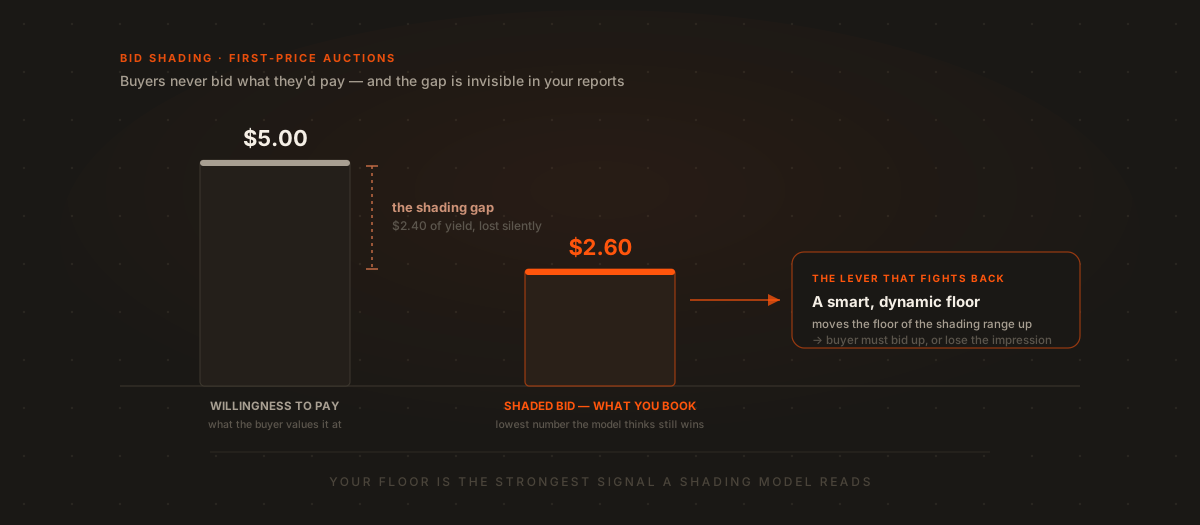
- Their shading model predicts $2.40 will win this auction.
- They bid $2.60 to be safe — and win at $2.60.
- You booked $2.60. The willingness-to-pay was $5.00.
Multiply that across every open-exchange impression and shading becomes one of the largest silent drains on publisher yield. And it compounds with the floor problem we covered in the dynamic floor pricing guide: if your floor is low, shading models shade all the way down to it. A lazy floor isn’t just a missed minimum — it’s an open invitation telling every buyer exactly how little they can bid.
How shading models actually decide
Modern shading isn’t a flat discount. It’s a per-impression prediction built on the same signals that drive value:
- Win-rate curves — historical data on what price cleared this placement, at this time, for this format.
- Competitive density — how many other buyers tend to show up for this auction. Thin competition means aggressive shading; a crowded auction forces honest bids.
- The floor itself — the single strongest signal a buyer has about the auction’s reserve. The floor anchors the entire shading calculation.
- Supply path — which exchange, how clean, how many duplicate paths to the same impression (the supply-chain transparency angle: duplicate paths let buyers shop the cheapest route to your inventory).
The takeaway: shading is a sophisticated read of your auction dynamics. The only way to fight an intelligent buyer is with an intelligent sell side.
The one lever that fights back
You can’t stop buyers from shading — it’s baked into first-price. But you can change the inputs their models read, and the most powerful input you control is the floor.
A smart, dynamic floor narrows the shading gap directly. If a buyer’s model wants to clear at $2.40 but your floor for that impression is $3.10, the buyer must either bid up to $3.10 or lose the impression entirely. You’ve moved the floor of the shading range up underneath them.
The catch — and it’s the whole game — is that a static floor does the opposite. Set it too high and you kill fills as buyers walk. Set it too low and you hand the shading model a green light. The optimal anti-shading floor is different for every impression and changes constantly, which is why it can’t be a number you set quarterly. It has to be a decision made per request, in real time, inside the auction — the same conviction behind everything we build.
What to actually do in 2026
-
Accept that you’re being shaded. Every open-exchange dollar runs through a shading model. This isn’t an edge case to ignore — it’s the default condition of first-price.
-
Treat your floor as an anti-shading tool, not just a minimum. The floor is the strongest signal a shading model reads. A smart floor is your most direct lever on the shading gap.
-
Watch the bid landscape, not just the clear price. If winning bids cluster right at your floor, shading models have found your reserve and are pinning to it — a sign your floor is leaving money on the table.
-
Shorten or eliminate the floor-review cycle. A floor reviewed quarterly is a floor a shading model has fully mapped within days. Per-impression, decided automatically, is the goal.
-
Clean up duplicate supply paths. Multiple routes to the same impression let buyers shade against the cheapest one. Fewer, cleaner paths mean less room to shop you down.
Lumorrow sets floors per impression, in real time, reading live auction signals to narrow the shading gap — pre-auction, not in a report you read later. See how the platform works → or explore it as a publisher →.