
Brand safety and suitability explained: keeping ads away from the wrong content
Brand safety keeps ads off harmful content; brand suitability tailors that line to each advertiser. Here's the difference, how blocklists and category controls work, why over-blocking hurts publishers, and how the field is moving from crude keywords to context.
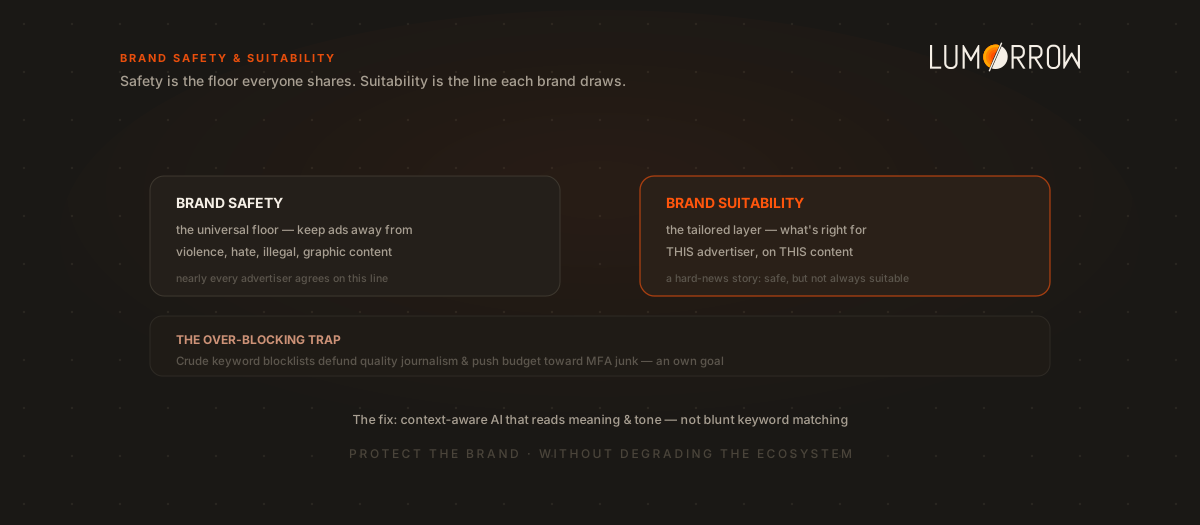
No advertiser wants its ad next to a terrorism story or a stream of hate speech. Preventing that is brand safety — and for years it was a blunt instrument that caused nearly as many problems as it solved. The more refined idea that’s replaced it, brand suitability, is one of the more important shifts in how quality is managed in programmatic.
Here’s what both mean, how they work, and why the distinction matters.
Brand safety vs. brand suitability
The two terms are related but not the same:
- Brand safety is the baseline: keeping ads away from universally harmful or objectionable content — violence, hate speech, illegal material, graphic content. This is a near-universal floor almost every advertiser agrees on.
- Brand suitability is the tailored layer: what’s appropriate for this specific advertiser. A hard-news story about a tragedy is brand-safe (it’s legitimate journalism), but it may not be suitable for a lighthearted consumer brand — while a news advertiser would happily run there.
The move from “safety” to “suitability” is the recognition that appropriateness isn’t one universal line — it depends on the brand, the campaign, and the context.
Brand safety is the floor everyone shares. Brand suitability is the line each advertiser draws for itself. Treating them as the same thing is what leads to crude over-blocking.
How it’s controlled
Advertisers and their partners enforce these lines with a few tools:
- Blocklists (and allowlists) — specific domains or apps to never (or only) run on.
- Keyword blocking — avoiding pages containing certain terms. The oldest method, and the most error-prone.
- Category controls — using content classification (via contextual analysis) to include or exclude whole categories of content.
- Verification vendors — independent measurement that grades whether ads actually ran in safe/suitable environments, pre-bid and post-bid.
The over-blocking problem
Crude brand-safety tooling has a costly failure mode: over-blocking. Naive keyword blocklists nuke legitimate content — a “shooting” blocklist blocks basketball and photography; blanket news blocks defund quality journalism by starving it of ads exactly when readership is highest. Over-blocking hurts good publishers, chokes hard news, and — because blocked inventory pushes budgets elsewhere — quietly concentrates spend on lower-quality made-for-advertising sites. The tool meant to protect brands ends up degrading the ecosystem they buy from.
The shift to context and suitability
The fix is smarter classification. Instead of matching keywords, modern brand suitability uses contextual AI that understands a page’s actual meaning, tone, and sentiment — distinguishing a news report about violence from content that glorifies it, or a tragedy story from satire. That page-level understanding lets each advertiser set a nuanced suitability line without carpet-bombing legitimate content. It also ties directly to ad fraud and quality: suitability is one dimension of whether an impression is worth buying at all.
The takeaway
Brand safety keeps ads away from universally harmful content; brand suitability tailors that line to each advertiser’s needs. The old tooling — keyword blocklists — was crude and over-blocked, hurting quality publishers and hard news while pushing budgets toward junk. The field is moving toward context-aware classification that understands what a page actually means, letting advertisers protect their brand without degrading the ecosystem. Safety is the floor; suitability, done with real context, is the upgrade.
Lumorrow evaluates context and quality on every bid request in real time, pre-auction — so suitability is judged on what a page actually is, not a blunt keyword match. See how the platform works →.