
Seller-defined audiences (SDA) explained: publisher audiences without user IDs
Seller-defined audiences let publishers declare audience cohorts directly in the bid request — no user identifier required. Here's how SDA works, the IAB taxonomy behind it, and why it's one of the most promising cookieless targeting approaches.
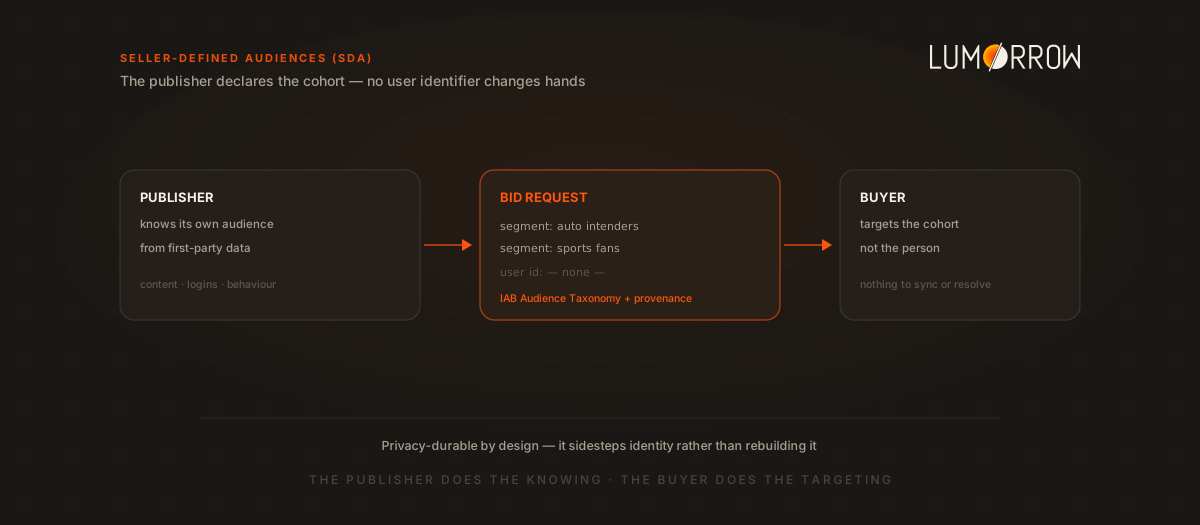
Here’s a problem the cookieless transition created for publishers: you know an enormous amount about your audience — who reads what, who’s authenticated, what they’re in market for — but the standard way to make that knowledge buyable relied on third-party identifiers that are disappearing. Seller-defined audiences (SDA) is the IAB Tech Lab standard built to solve exactly that, and it’s one of the more elegant answers in the post-cookie toolkit.
Here’s how it works.
What SDA is
Seller-defined audiences let a publisher (the seller) declare audience cohorts directly in the bid request, so buyers can target them — without passing any user identifier at all.
Instead of saying “this is user abc-123, go look up what you know about them,” the publisher says: “this impression belongs to someone in the ‘auto intenders’ and ‘sports enthusiasts’ cohorts.” The buyer targets the cohort. No cross-site ID changes hands, and no one has to resolve an individual identity.
The publisher builds those cohorts from what it legitimately knows — its own first-party data: content consumed, authenticated profile, on-site behavior, declared preferences.
Old model: pass an ID and let the buyer figure out who the person is. SDA: skip the ID entirely and just declare what segment they’re in. The publisher does the knowing; the buyer does the targeting.
The taxonomy makes it work
A publisher declaring “sports fans” is useless if every publisher labels things differently — a buyer can’t plan a campaign across a hundred bespoke vocabularies. SDA’s crucial ingredient is therefore a shared taxonomy: IAB Tech Lab’s Audience Taxonomy, which gives standardized IDs for audience segments (demographics, interests, purchase intent).
Both sides speak the same segment vocabulary, so “in-market for a new vehicle” means the same thing on every publisher — the same interoperability logic that made OpenRTB work for bidding. SDA also uses a data-provenance signal indicating where the segment came from and how it was derived, so buyers can judge its trustworthiness.
Why it matters
SDA lines up neatly with where the industry is going:
- It’s privacy-durable. No third-party cookie, no shared user ID, nothing to sync. It sidesteps the entire identity problem rather than trying to rebuild it, so cookie deprecation doesn’t break it.
- It puts publishers back in control. The publisher monetizes its own audience knowledge directly, instead of watching third parties resell data derived from its readers. That’s real leverage for a business whose main asset is audience understanding.
- It scales across the open web. Standard taxonomy means a buyer can assemble reach across many publishers — the thing walled gardens do easily and the open web has struggled with.
- It fits curation. SDA segments are a natural ingredient in curated marketplaces and PMP deals.
The honest limitations
SDA isn’t a complete replacement for identity-based targeting:
- Trust and verification. The publisher is asserting the cohort, and there’s no automatic way for a buyer to audit that “auto intenders” was built rigorously. Provenance signals help; buyer trust in the seller still matters — the same accountability theme running through supply-chain transparency.
- Coverage depends on the publisher. SDA is only as rich as a publisher’s own first-party data, so it favors those with authenticated audiences and real analytics.
- No cross-publisher frequency or measurement. Without an identifier, you can’t dedupe a person across sites, so frequency capping and cross-site attribution remain hard.
- Adoption is uneven. It only pays off when enough publishers implement it and enough buyers activate it.
The takeaway
Seller-defined audiences let publishers declare standardized audience cohorts in the bid request using their own first-party data, so buyers can target meaningful segments without any user identifier being passed. Built on the IAB Audience Taxonomy plus provenance signals, it’s privacy-durable by design, gives publishers control of their most valuable asset, and offers the open web a way to sell audiences at scale. The open questions are trust, verification, and adoption — but as a cookieless targeting model, SDA is one of the most structurally sound ideas available.
Lumorrow evaluates the declared signals on every bid request — audiences, provenance, and supply quality — in real time, pre-auction. See how the platform works → or explore it as a publisher →.