
Data clean rooms explained: matching data without exposing it
A data clean room lets two parties combine their data to find overlap and measure results — without either side seeing the other's raw records. Here's how clean rooms work, what they're used for, and why they've become central to privacy-safe advertising.
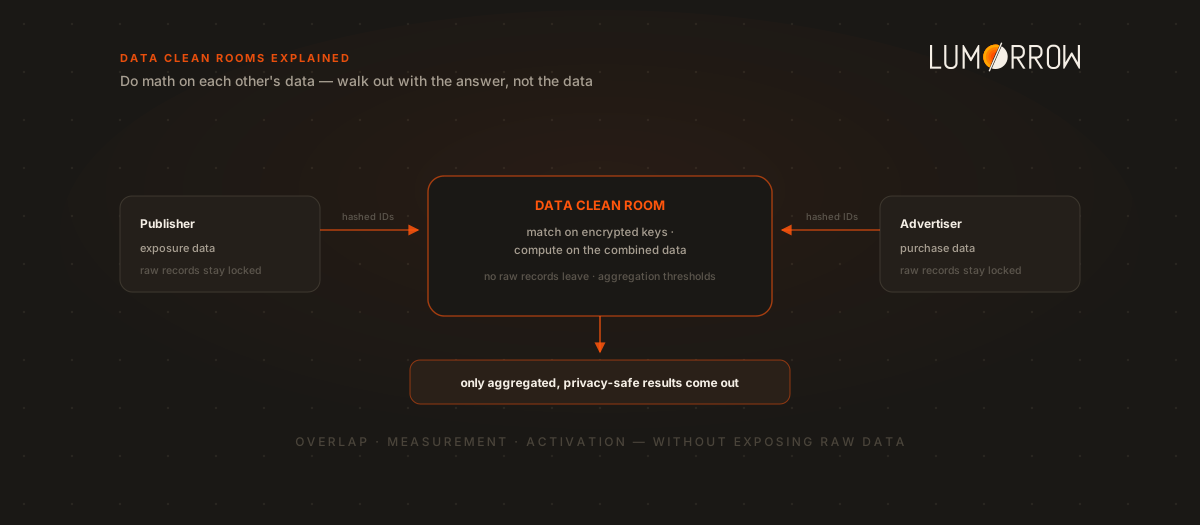
As advertising shifts from borrowed third-party data to owned first-party data, a new problem appears: a publisher and an advertiser each have valuable data about the same people, but neither can legally or safely hand its raw records to the other. The data clean room is the mechanism built to solve exactly that — collaborate on data without exposing it.
Here’s what a clean room is, how it works, and why it’s become central to modern advertising.
The problem clean rooms solve
Say a retailer wants to know whether the people who saw a publisher’s ad campaign later bought its product. Answering that requires matching the publisher’s exposure data against the retailer’s purchase data. But:
- The publisher can’t hand over its users’ data — privacy law, consent terms, and competitive sense all forbid it.
- The retailer can’t hand over its customer purchase records for the same reasons.
Both sides have a piece of the answer; neither can share its piece. That standoff is what a clean room resolves.
What a data clean room is
A data clean room is a secure, neutral environment where two (or more) parties bring their data together to run analysis — but with strict rules that prevent either party from seeing the other’s raw, individual-level records. You can compute on the combined data; you can’t extract the other side’s data.
The typical guardrails:
- No raw data leaves. Each party’s underlying records stay protected; only aggregated, privacy-safe results come out.
- Matching happens on hashed identifiers. The two datasets are joined on encrypted keys (like hashed emails), so overlap can be found without exposing identities.
- Aggregation thresholds. Outputs are only released above a minimum audience size, so no individual can be reverse-engineered from the results.
A clean room is a room where two companies can do math on each other’s data — and walk out with the answer, but not with each other’s data.
What clean rooms are used for
Three main jobs:
- Audience overlap and enrichment — finding the shared audience between a publisher and an advertiser, so a brand can reach exactly the people it cares about on that publisher’s inventory.
- Measurement and attribution — connecting ad exposure to outcomes (like purchases) to prove a campaign worked, without either side exposing raw logs. This is the engine behind retail media closed-loop measurement.
- Activation — building and targeting audiences for a campaign based on the matched, privacy-safe result.
Why they matter now
Clean rooms went from niche to essential for one reason: they’re how first-party data gets used in a world without third-party cookies. As the cookieless shift removed the easy (if privacy-hostile) way to match audiences across the web, clean rooms became the privacy-safe replacement — the venue where premium, consented data collaborations happen. They’re not without friction (interoperability between different clean-room platforms is a real challenge), but they’ve become the standard tool for high-value data partnerships.
The takeaway
A data clean room lets two parties combine their data to find overlap and measure results without either one seeing the other’s raw records — matching on hashed keys, releasing only aggregated outputs. As advertising moves to first-party data, clean rooms are how that data gets activated and measured safely. If first-party data is the durable asset, the clean room is increasingly the place where its value is unlocked.
Lumorrow focuses on the real-time, pre-auction layer — evaluating supply quality and validity before the impression is billed — complementing the privacy-safe data collaboration that clean rooms enable. See how the platform works →.