
Retail media networks explained: why every retailer is now an ad platform
Retail media networks let retailers sell advertising against their own shopper data and inventory. It's the fastest-growing channel in advertising. Here's what an RMN is, why retailers are racing to build them, and how they work on and off the retailer's site.
A few years ago, “retail media” meant sponsored products on a shopping site. Today it’s the fastest-growing channel in all of advertising, and nearly every large retailer, grocer, and marketplace is racing to build one. If you work anywhere near ad tech, you need to understand why.
Here’s what a retail media network is, why it exploded, and how it actually works.
What a retail media network is
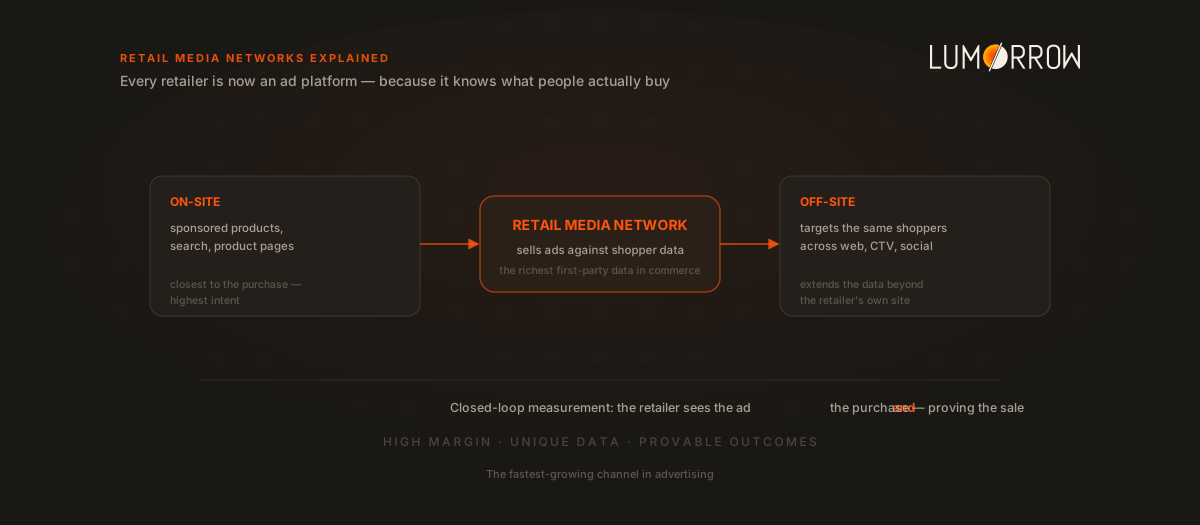
A retail media network (RMN) is an advertising business run by a retailer, selling ad placements against its own shopper data and inventory. When a brand pays to appear at the top of a retailer’s search results, or in a “sponsored” slot on a product page, that’s retail media.
The reason it’s powerful comes down to one thing: the retailer knows what people actually buy. Not what they browsed, not what a model inferred — what they purchased, with a card, at checkout. That’s the richest first-party data in commerce, and it sits right next to the moment of purchase.
Why retailers are racing to build them
Three forces made RMNs irresistible:
- Margins. Retail is a thin-margin business. Advertising is a high-margin one. Selling ads against traffic a retailer already has drops almost straight to the bottom line.
- The data is uniquely valuable. As third-party signals erode, purchase-based first-party data becomes one of the few durable, high-accuracy targeting signals left. Retailers are sitting on exactly that.
- Closed-loop measurement. Because the retailer sees both the ad exposure and the purchase, it can prove an ad drove a sale — the holy grail advertisers have chased for decades.
A retailer knows what you bought, not just what you clicked. That closed loop — ad to actual purchase — is what makes retail media data worth more than almost anything else in advertising.
On-site vs. off-site retail media
RMNs operate in two arenas:
On-site — ads on the retailer’s own properties: sponsored product listings, search results, banners on product and category pages. This is where retail media started, it’s closest to the purchase, and it’s the highest-intent inventory a brand can buy.
Off-site — the retailer uses its shopper data to target the same customers elsewhere on the open web, in CTV, or in social — then closes the loop by matching exposure back to in-store or online purchases. This is where much of the future growth is, because it extends the retailer’s valuable data far beyond its own site.
How it connects to programmatic
Off-site retail media runs on the same programmatic plumbing as everything else — DSPs, SSPs, exchanges — with the retailer’s first-party audience layered on for targeting and measurement. Increasingly, RMNs are also curating their own inventory and deals, which ties directly into supply path optimization and the broader question of clean, verifiable supply.
The takeaway
A retail media network is a retailer turning its two most valuable assets — shopper data and audience attention — into an advertising business. It works because purchase data is the most accurate targeting signal in commerce and because the retailer can prove ads drove sales. Starting on-site and expanding off-site, RMNs have become the fastest-growing channel in advertising — and a reminder that in a first-party-data world, whoever owns the customer relationship owns the most valuable ad inventory.
Lumorrow’s real-time, pre-auction intelligence helps any marketplace — retail media networks included — evaluate supply quality and value each impression correctly. See how the platform works → or explore it for demand partners →.