
The ad tech tax explained: where the programmatic dollar actually goes
Of every dollar an advertiser spends programmatically, only a fraction reaches the publisher. The rest — the 'ad tech tax' — is taken by intermediaries. Here's where the money goes, why so much is unaccounted for, and how transparency fights back.
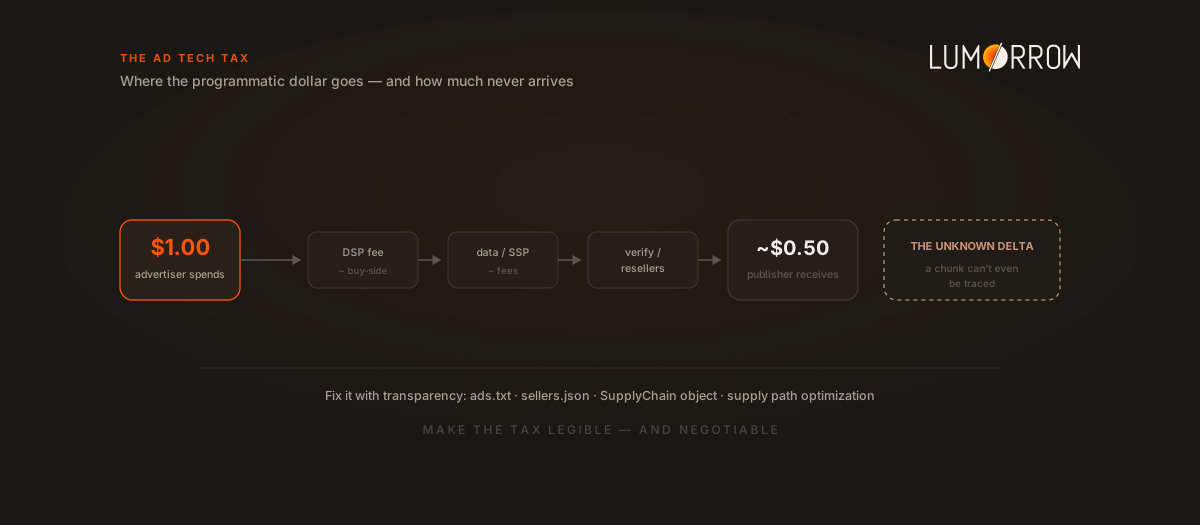
Here’s a number that should bother anyone who spends money on programmatic: of every dollar an advertiser puts in, a large share — often something like half — never reaches the publisher who actually showed the ad. It’s absorbed along the way by the chain of intermediaries between buyer and seller. That gap is the ad tech tax, and understanding it is central to understanding why supply-chain transparency matters.
Here’s where the money goes and why so much of it is hard to trace.
What the ad tech tax is
The ad tech tax is the total cut taken by all the intermediaries between an advertiser and a publisher — the combined fees of DSPs, SSPs, exchanges, data providers, verification vendors, and any resellers in the supply chain.
Landmark industry studies (most famously the ISBA/PwC programmatic supply chain study) found that only around half of advertiser spend reached publishers as working media, with the rest consumed by the tech in between. The proportions vary by path and setup, but the headline holds: a big fraction of every programmatic dollar is intermediation.
Where the dollar goes
Follow a single advertiser dollar down the programmatic chain:
- The DSP takes a fee for buy-side execution.
- Data and targeting providers take a cut for audience segments.
- The exchange / SSP takes a fee for running the auction and connecting supply.
- Verification and measurement vendors charge for fraud, viewability, and brand-safety checks.
- Resellers and intermediaries in a long supply path each take their own margin.
- What’s left reaches the publisher as working media.
Each fee can be individually reasonable — these are real services. The problem is the cumulative drag, and how much of it is invisible.
The “unknown delta”
The most damning finding from supply-chain studies wasn’t just the size of the tax — it was the part nobody could explain. A meaningful chunk of spend couldn’t be matched between what buyers paid and what sellers received: an “unknown delta” that disappeared into the chain with no clear attribution. Money went in, less came out, and the difference couldn’t be fully traced. That opacity — not just the fees themselves — is the real scandal, because you can’t manage or negotiate a cost you can’t even see.
Individually, every fee in the chain has a justification. Collectively, they can consume half the budget — and a chunk of that can’t even be traced. The problem isn’t that intermediation costs money; it’s that so much of it is invisible.
How transparency fights back
The tools that reduce the ad tech tax are the same ones that bring supply-chain transparency:
- ads.txt and sellers.json make the authorized sellers and their identities public, exposing unauthorized resellers taking a cut.
- The SupplyChain object names every hop, so buyers can see the path — and its length.
- Supply path optimization concentrates spend on short, efficient, transparent paths, cutting redundant intermediary fees.
- Curation and log-level data give buyers more visibility into what they’re actually paying for — though curation can also add a layer if not transparent about its own fee.
- Direct and supply-path deals shorten the chain, leaving more as working media.
The goal isn’t zero intermediation — it’s legible intermediation: knowing exactly what each layer costs and choosing paths accordingly.
The takeaway
The ad tech tax is the combined cut of every intermediary between advertiser and publisher, and industry studies suggest it can consume roughly half of programmatic spend — with a portion so opaque it can’t even be traced. The individual fees are for real services; the problem is the cumulative drag and the invisibility. Transparency tools — ads.txt, sellers.json, the SupplyChain object, supply-path optimization — are how buyers turn an untraceable tax into a set of visible, negotiable costs, and get more of every dollar onto real inventory.
Lumorrow evaluates supply-path quality and provenance on every bid request in real time, pre-auction — helping keep the path short, legible, and worth what it costs. See how the platform works → or read the supply-chain transparency guide →.