
Ad networks vs ad exchanges explained: aggregation vs the open auction
Ad networks and ad exchanges both connect buyers and sellers, but they work differently. Networks aggregate and resell inventory in bundles; exchanges run a real-time auction on each impression. Here's the difference, the history, and where networks still fit.
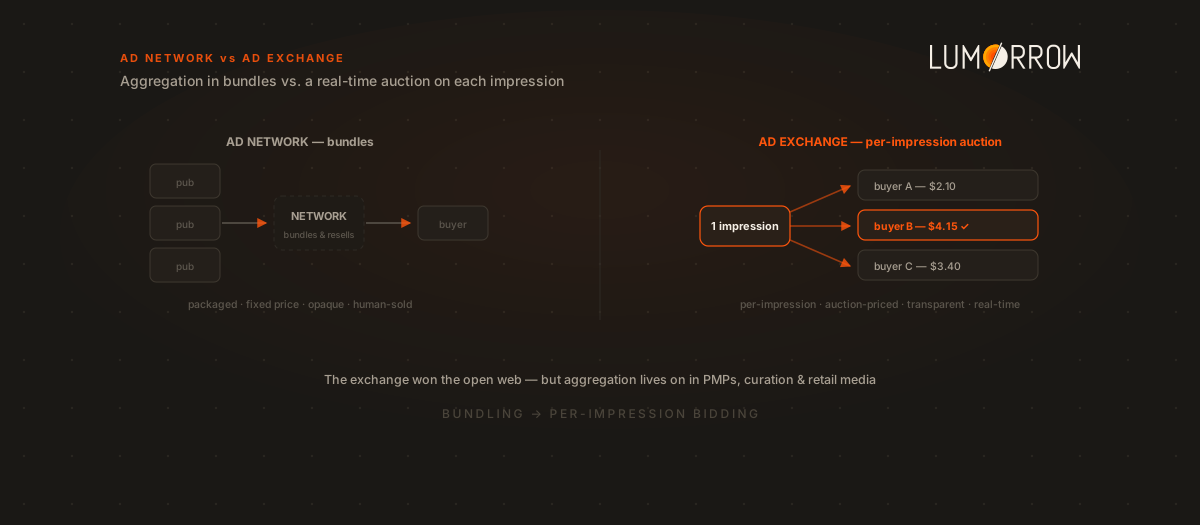
Ad network and ad exchange are two of the most-confused terms in ad tech, partly because the exchange grew out of the network’s limitations. Both connect advertisers who want to buy with publishers who want to sell — but how they do it is fundamentally different, and that difference is basically the story of how programmatic came to be.
Here’s the distinction, the history, and where each still fits.
The ad network: aggregation
An ad network aggregates inventory from many publishers and resells it to advertisers, usually in bundles. The network sits in the middle: it buys or represents unsold inventory across a set of publishers, packages it into audience or category segments, and sells those packages to advertisers — often at a negotiated or fixed price.
The defining traits:
- Bundled, not per-impression. You buy a package (“sports sites,” “women’s lifestyle”), not individually-evaluated impressions.
- Opaque by design. Advertisers often didn’t know exactly which sites an impression ran on; publishers often didn’t know exactly who bought it. The network’s margin lived in that opacity.
- Human-negotiated. Deals were set up by salespeople, not decided in milliseconds.
Ad networks were the dominant model in the 2000s, and they solved a real problem — helping publishers fill unsold inventory and helping advertisers buy at scale. But the opacity and the bundling left money and control on the table.
The ad exchange: the open auction
An ad exchange replaced bundling with a per-impression auction. Instead of packaging inventory in advance, the exchange runs a live real-time auction on each individual impression, letting many buyers bid on it simultaneously and awarding it to the highest bid.
The defining traits:
- Per-impression, not bundled. Every impression is evaluated and priced individually.
- Transparent(er) and automated. Buyers see (much more about) what they’re bidding on; the auction, not a salesperson, sets the price.
- Real-time. The whole thing happens in the ~100 milliseconds a page takes to load.
The exchange is what made programmatic possible — buying decisions at the level of the individual impression, at machine speed and scale.
A network sells inventory in pre-packaged bundles at a negotiated price. An exchange auctions each impression individually in real time. Bundling vs. per-impression bidding is the whole difference — and the reason the exchange won the open web.
Why the exchange largely won — and where networks remain
The exchange’s per-impression transparency and efficiency made it the backbone of the open web, and much of what were once “networks” evolved into SSPs and exchanges. But the network model didn’t vanish — it adapted:
- Curated marketplaces and deal types (PMPs, packages) are, in a sense, networks rebuilt on programmatic rails — aggregation and curation, but with the transparency and auction mechanics of the exchange.
- Vertical and specialist networks still thrive where curation, unique inventory, or a specific audience is the value.
- Retail media networks are a modern, data-rich descendant of the aggregation model.
So the honest picture isn’t “exchange killed network” — it’s that the two models converged, with aggregation and curation now running on top of transparent, per-impression programmatic infrastructure.
The takeaway
An ad network aggregates inventory and resells it in bundles at negotiated prices; an ad exchange runs a transparent, real-time auction on each individual impression. The exchange’s per-impression model powered the rise of programmatic and became the open web’s backbone — but the network’s aggregation-and-curation logic lives on in PMPs, curated marketplaces, and retail media, now built on programmatic rails. Knowing which model you’re buying through tells you how transparent, granular, and dynamic the transaction really is.
Lumorrow is an AI-native exchange that adds real-time, pre-auction intelligence to the per-impression auction — evaluating quality before the impression is billed. See how the platform works → or read SSP vs DSP vs ad exchange →.