
Audience targeting types explained: the main ways ads find their audience
Demographic, behavioral, contextual, geographic, retargeting, and lookalike — digital advertising targets audiences in several distinct ways. Here's what each targeting type means, how they differ, and how the cookieless shift is reshaping the mix.
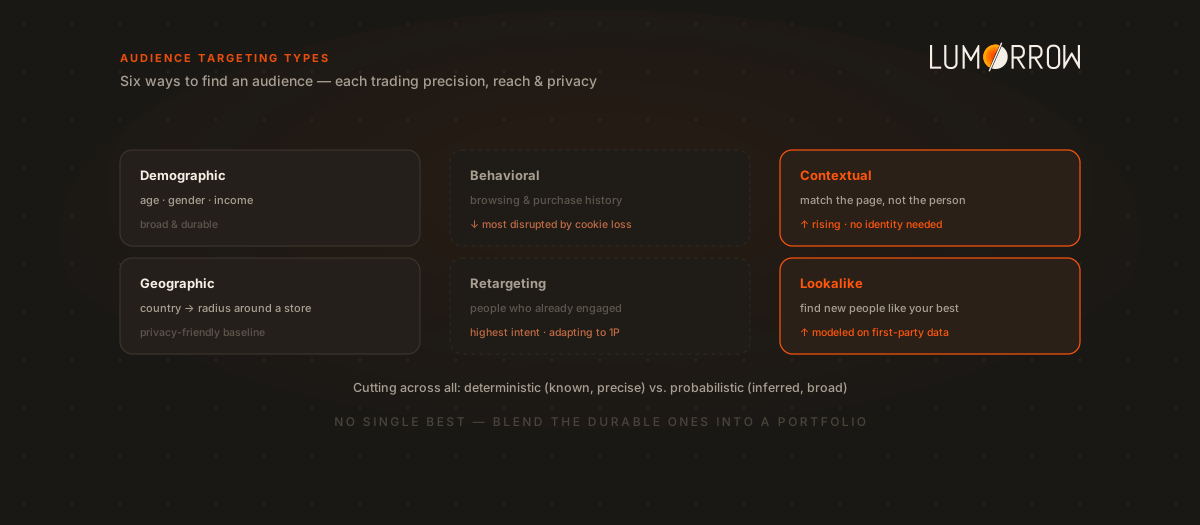
“Targeting” is a single word that hides at least half a dozen genuinely different techniques — and knowing which is which matters more than ever, because the cookieless shift is helping some thrive and quietly killing others. Here’s a clear map of the main audience targeting types, how they work, and where each stands in 2026.
The main targeting types
Demographic targeting. Reaching people by attributes like age, gender, income, education, or household composition. The oldest and broadest approach — the digital descendant of linear TV’s “adults 25–54.” Simple and durable, but coarse.
Behavioral targeting. Reaching people based on their past behavior — browsing history, purchases, content consumed — to infer interests and intent (“in-market for a car”). Historically the most powerful and precise approach, and historically the most dependent on third-party cookies tracking users across the web. It’s the type most disrupted by privacy changes.
Contextual targeting. Matching ads to the content of the page rather than the identity of the user — a running-shoe ad on a marathon article. Needs no user identity at all, so it’s privacy-durable, and modern AI has made it genuinely smart. Rising fast in the cookieless era.
Geographic (geo) targeting. Reaching people by location — country, region, city, or a radius around a point. Ranges from broad (a national campaign) to hyper-local (a radius around a store). It’s the primary targeting mode for DOOH and location-based mobile, and relatively privacy-friendly when done at an area level.
Retargeting. Reaching people who already interacted with a brand — visited the site, viewed a product, abandoned a cart. The highest-intent targeting, and, like behavioral, built on cookies and now adapting to first-party approaches.
Lookalike (audience modeling). Starting from a seed audience (say, your best customers) and finding new people who statistically resemble them. It’s how advertisers scale beyond a known audience, powered by modeling on top of first-party data.
Deterministic vs. probabilistic
Cutting across all of these is a second distinction worth knowing:
- Deterministic targeting uses known, confirmed data — a logged-in user, a hashed email — for high certainty about who someone is.
- Probabilistic targeting infers identity or attributes from signals (device, behavior, patterns) — broader reach, lower certainty.
The same trade-off runs through identity resolution: precision versus scale.
There’s no single “best” targeting type — each trades precision, reach, and privacy-durability differently. The winning approach in 2026 isn’t picking one; it’s blending the durable ones into a portfolio.
How the cookieless shift is reshaping the mix
The move away from third-party identifiers is redistributing which techniques thrive:
- Rising: contextual (no identity needed), first-party-based (retargeting and lookalikes built on owned data), and geographic — all durable without third-party cookies.
- Under pressure: cross-web behavioral targeting and cookie-based retargeting, which depended on tracking individuals across sites.
- The strategy: a portfolio — first-party data where you have relationships, contextual everywhere else, geo and demographic as durable baselines, and privacy-safe modeling (clean rooms) to extend reach.
The takeaway
Digital advertising targets audiences in several distinct ways — demographic, behavioral, contextual, geographic, retargeting, and lookalike — each trading precision, scale, and privacy-durability differently, and each either deterministic or probabilistic underneath. The cookieless shift is the key dynamic: it’s boosting the identity-independent methods (contextual, geographic) and first-party approaches while eroding cross-web behavioral targeting. The durable move isn’t betting on one technique; it’s assembling the resilient ones into a portfolio built on data you actually own.
Lumorrow evaluates the consented targeting signals on each bid request in real time, pre-auction — so each impression is valued on what’s genuinely known and permitted. See how the platform works →.