
Cookie syncing explained: how ad tech platforms matched IDs (and why it's ending)
Cookie syncing let different ad tech platforms agree that their separate IDs referred to the same user. Here's how the ID-matching handshake worked, why it was slow and leaky, and what's replacing it as third-party cookies disappear.
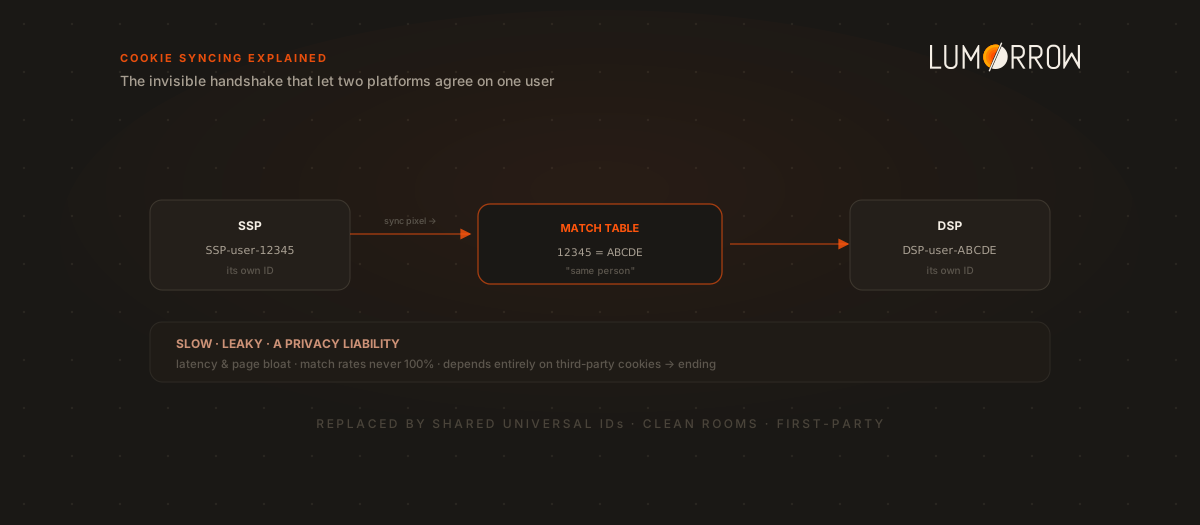
Cookie syncing is one of the least-visible and most-consequential mechanisms in the history of programmatic. It’s the reason different ad tech companies could agree they were talking about the same user — and its messy limitations are a big part of why the industry is moving to new identity approaches. Understanding it explains both how targeting worked and why it’s changing.
Here’s how cookie syncing worked and what’s replacing it.
The problem: everyone had their own ID
Third-party cookies had a crucial limitation: a cookie can only be read by the domain that set it. So an SSP knew a user as SSP-user-12345, while a DSP knew the same person as DSP-user-ABCDE. Neither could read the other’s cookie. For programmatic to work — for a DSP to recognize and bid on a user an SSP was offering — the two platforms needed to agree that their two IDs were the same person.
Cookie syncing is the handshake that made that agreement.
How cookie syncing worked
The mechanism is a behind-the-scenes ID exchange, usually via invisible pixels:
- A user visits a page. Platform A (say, the SSP) fires a tiny, invisible pixel that calls Platform B (the DSP).
- In that call, Platform A passes along its ID for the user (
SSP-user-12345). - Platform B reads its own cookie for that same browser (
DSP-user-ABCDE) and now stores a mapping: “SSP-12345 = my ABCDE.” - Later, when the SSP offers an impression for
SSP-user-12345in a bid request, the DSP looks up its match table, recognizes the user, and can bid intelligently.
Multiply that handshake across thousands of platform pairs and you get the vast, invisible ID-matching mesh that made cross-platform targeting, retargeting, and frequency capping possible.
Cookie syncing was the translation layer of programmatic — a constant background handshake so a dozen companies could agree that their dozen different IDs all pointed to one person. Invisible, essential, and deeply inefficient.
Why it was a problem
Cookie syncing worked, but it was ugly:
- Slow and heavy. All those syncing pixels added latency and page bloat — real performance cost for users.
- Leaky. Match rates were never 100%; IDs were lost constantly as cookies were cleared or expired, so a lot of matching simply failed.
- A privacy liability. A sprawling, invisible mesh of companies quietly exchanging user identifiers is precisely the kind of tracking that privacy regulation and browser makers set out to end.
That last point is decisive: cookie syncing depends entirely on third-party cookies, and as those disappear across browsers, the whole mechanism collapses.
What’s replacing it
The successors are the same portfolio replacing the cookie everywhere:
- Shared universal IDs. Instead of every platform maintaining its own ID and syncing pairwise, participants adopt a common identifier (often built on authenticated, hashed emails), so no translation is needed.
- Data clean rooms. Privacy-safe matching in a controlled environment rather than an open pixel mesh.
- First-party and contextual approaches. First-party IDs and contextual targeting, which sidestep cross-platform user matching altogether.
The common thread: replace the leaky, invisible, pairwise handshake with either a shared standard or a privacy-safe environment.
The takeaway
Cookie syncing was the behind-the-scenes handshake that let different ad tech platforms agree their separate third-party-cookie IDs referred to the same user — the translation layer that made cross-platform targeting and frequency capping possible. It was slow, leaky, and a privacy liability, and because it depends entirely on third-party cookies, it’s ending. Its replacements — shared universal IDs, clean rooms, and first-party/contextual methods — aim to do the same job without the invisible mesh of identifier-swapping that defined the cookie era.
Lumorrow evaluates each bid request on whatever consented signals it carries, in real time, pre-auction — built for an identity landscape moving past the old cookie-syncing mesh. See how the platform works →.