
Cross-device tracking and identity graphs explained: one person, many screens
People use a phone, a laptop, a tablet, and a TV — and advertising needs to know they're all the same person. Cross-device identity graphs solve that. Here's how they work, deterministic vs. probabilistic matching, and why privacy is reshaping them.
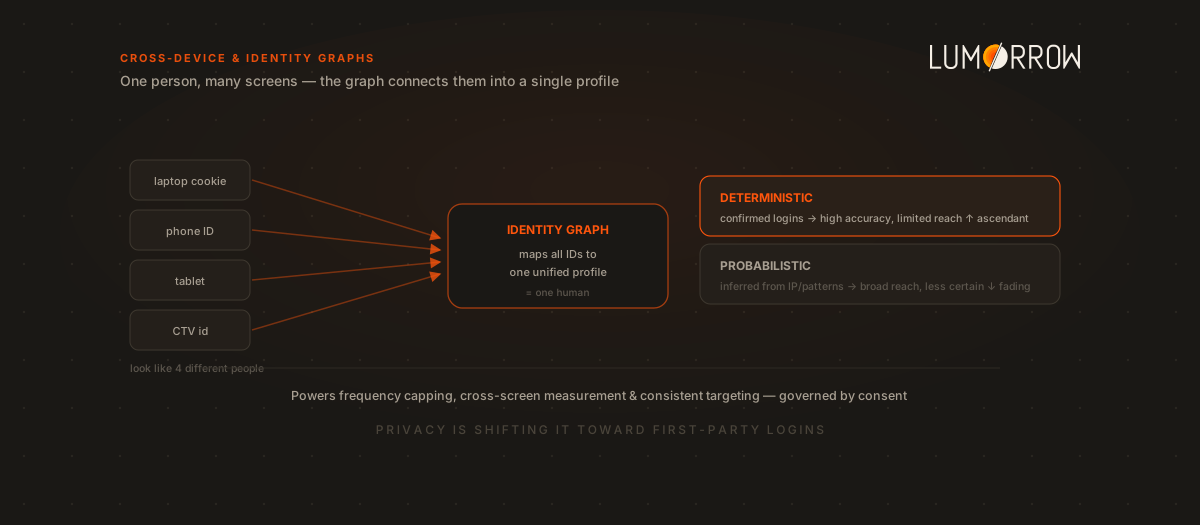
The average person touches a phone, a laptop, a tablet, and a connected TV in a single day — and to advertising, each of those can look like a different person. Recognizing that they’re all one human is the cross-device problem, and the tool built to solve it is the identity graph. It underpins frequency capping, measurement, and consistent targeting across screens — and it’s being reshaped by privacy.
Here’s how cross-device identity works.
The problem: one person, many devices
A single user generates many separate signals — a cookie on a work laptop, a different cookie on a home browser, a device ID on a phone, another on a tablet, a connected-TV identifier. Left unconnected, advertising treats them as five different people. That breaks nearly everything:
- Frequency capping fails — the same person gets hit the cap’s worth of ads on each device.
- Measurement double-counts — one person looks like five in reach reports.
- The journey is invisible — someone who researches on a phone and buys on a laptop looks like two unrelated events.
What an identity graph is
An identity graph is a database that maps the many identifiers belonging to the same person (or household) into a single, unified profile. It’s the connective tissue that says “this laptop cookie, this phone ID, and this CTV identifier are all the same human” — so advertising can treat them as one.
The graph is what makes cross-device retargeting, unified frequency capping, and cross-screen measurement possible. It’s closely related to identity resolution and universal IDs — the graph is the underlying map; universal IDs are a shared way to reference it.
Deterministic vs. probabilistic matching
Identity graphs are built two ways, and the distinction defines their accuracy:
- Deterministic matching links devices using confirmed signals — most powerfully, a user logging in with the same account (or email) across devices. High confidence: you know it’s the same person because they identified themselves. The limitation is coverage — it only works where people authenticate.
- Probabilistic matching infers that devices belong to the same person from patterns — shared IP addresses, location, Wi-Fi networks, behavioral similarity, timing. Broader reach (it can connect devices even without logins), but lower certainty and more privacy scrutiny.
Most real-world graphs blend both: a deterministic backbone from authenticated users, extended probabilistically for scale.
Deterministic matching knows it’s the same person because they told you. Probabilistic matching guesses from the breadcrumbs. Accuracy vs. reach — the same trade-off that runs through all of modern identity.
Why privacy is reshaping it
Cross-device graphs sit right in the path of the privacy transition, because linking a person’s devices is exactly the kind of tracking regulation and browsers are constraining:
- Third-party signals are fading. Probabilistic matching leaned heavily on cookies and cross-site signals; as those disappear, that approach weakens.
- Deterministic is ascendant. First-party, authenticated, consented logins are the durable foundation for cross-device identity now — which is why logged-in relationships are so valuable.
- Consent governs it. Linking devices requires a lawful basis; the graph is only usable where the user permitted it.
- Household-level approaches (treating a home as the unit, common in CTV) offer a privacy-friendlier middle ground.
The takeaway
Cross-device tracking connects the many identifiers a single person generates — laptop, phone, tablet, TV — into one profile via an identity graph, so advertising can cap frequency, measure reach, and target consistently across screens instead of treating one human as five. Graphs are built deterministically (from confirmed logins, high accuracy) and probabilistically (from inferred patterns, high reach). Privacy is shifting the balance decisively toward deterministic, first-party, consented identity — the durable way to know that all those screens belong to the same person.
Lumorrow evaluates the consented identity and quality signals on each bid request in real time, pre-auction — valuing every impression on what’s genuinely known about it. See how the platform works →.