
In-game advertising explained: ads inside the world, not around it
In-game advertising places ads inside gameplay environments — on virtual billboards, in rewarded video, and in branded items. Here's how intrinsic and interstitial in-game formats work, how they're measured, and why the channel is growing.
Gaming is one of the largest media categories on earth and, for years, one of the least accessible to advertisers. That’s changed: in-game advertising has matured into a genuine programmatic channel with its own formats, standards, and measurement approaches. If you’re mapping where audience attention actually sits, this is a channel worth understanding.
Here’s how in-game advertising works.
Two fundamentally different approaches
The most useful distinction is whether the ad lives inside the game world or interrupts it:
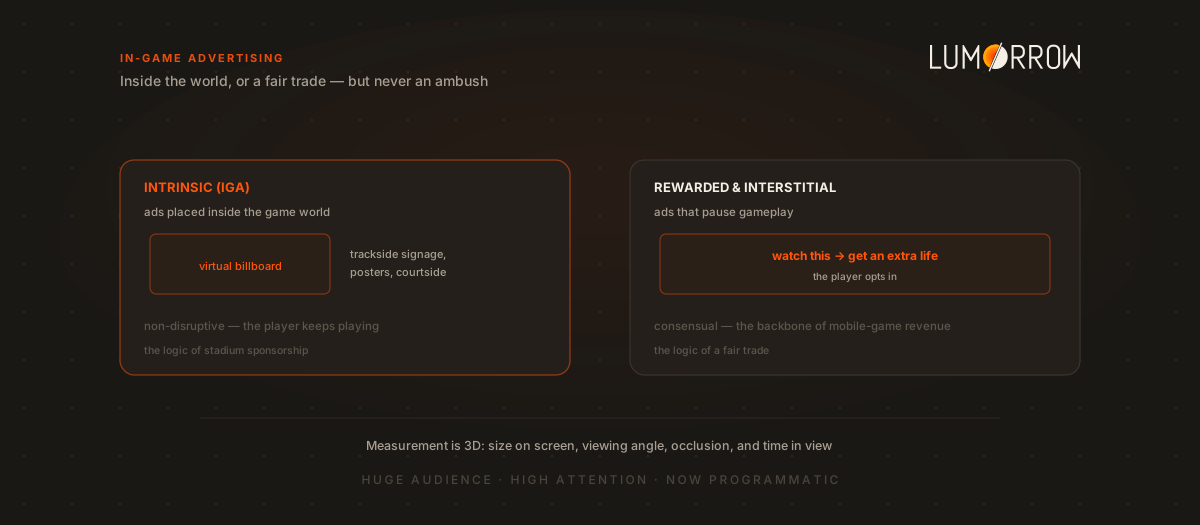
Intrinsic in-game (IGA). Ads placed within the game environment as native objects — a billboard along a racetrack, a poster in a virtual city, courtside signage in a sports title. The player keeps playing; the ad is part of the scenery, mirroring how real-world sponsorship works. It’s non-disruptive by design, which is why it’s favoured in premium and console titles.
Interstitial and rewarded formats. Ads that pause gameplay — a full-screen ad between levels, or, most importantly, rewarded video, where the player chooses to watch an ad in exchange for an in-game benefit (an extra life, currency, a hint). Rewarded video is the workhorse of mobile-game monetization precisely because it’s consensual: the player opts in and gets something, so the experience isn’t resented.
There’s also branded content and integrations — sponsored items, skins, or in-game events — which sit closer to partnership than to media buying.
Intrinsic ads borrow the logic of stadium signage: present, unobtrusive, part of the environment. Rewarded video borrows the logic of a fair trade: watch this, get something. Both work because neither is an ambush.
Why the channel grew up
- The audience is enormous and broad. Gaming spans demographics far past the old stereotype, and reaches people who are light TV viewers.
- Attention is unusually high. Players are leaned-in and focused for long sessions — a stark contrast to a scrolled-past banner.
- Programmatic pipes now exist. In-game inventory is increasingly transactable through standard programmatic infrastructure, so buyers can access it with existing tools rather than bespoke deals.
- Standards matured. IAB Tech Lab guidance on intrinsic in-game measurement gave the industry a common basis for what counts as a viewable in-game impression — the historical blocker to serious budgets.
The measurement problem — and its fix
In-game measurement is genuinely harder than display, because a billboard in a 3D world can be at any distance, angle, or occlusion. A “served” impression means nothing if the sign was behind the player, tiny on the horizon, or blocked by a wall.
So in-game viewability standards account for spatial factors: the ad’s size on screen, its viewing angle, whether it’s occluded, and how long it remained in view — a 3D extension of the logic behind display viewability. Only impressions meeting those thresholds should count. When evaluating in-game inventory, that’s the first question to ask: how is a viewable impression defined here, and who verifies it?
What buyers should watch
- Brand suitability varies hugely by title and by whether user-generated content is present — the suitability question, applied to game worlds.
- Creative must respect the environment. Intrinsic placements work when they look like they belong; jarring creative breaks immersion and annoys players.
- Verify the viewability definition, since standards adoption is uneven across vendors.
- Fraud diligence still applies — as with any channel, inventory quality and supply path deserve scrutiny.
The takeaway
In-game advertising splits into intrinsic placements inside the game world (billboards and signage, non-disruptive by design) and interruptive formats led by rewarded video (consensual, and the backbone of mobile-game monetization). It’s grown up because the audience is huge and attentive, programmatic access now exists, and measurement standards finally define what a viewable in-game impression means in three dimensions. Buy it with attention to viewability definitions, brand suitability by title, and creative that respects the world it sits in.
Lumorrow evaluates supply quality and validity in real time, pre-auction, across emerging channels — so new inventory is judged on what it actually delivers. See how the platform works →.