
Your first 30 days on a new exchange
A new demand partner rarely performs on day one, and judging it in week one is how good partners get cut early. Here's a 30-day ramp: what to check, what to ignore, and the one number that should decide it.
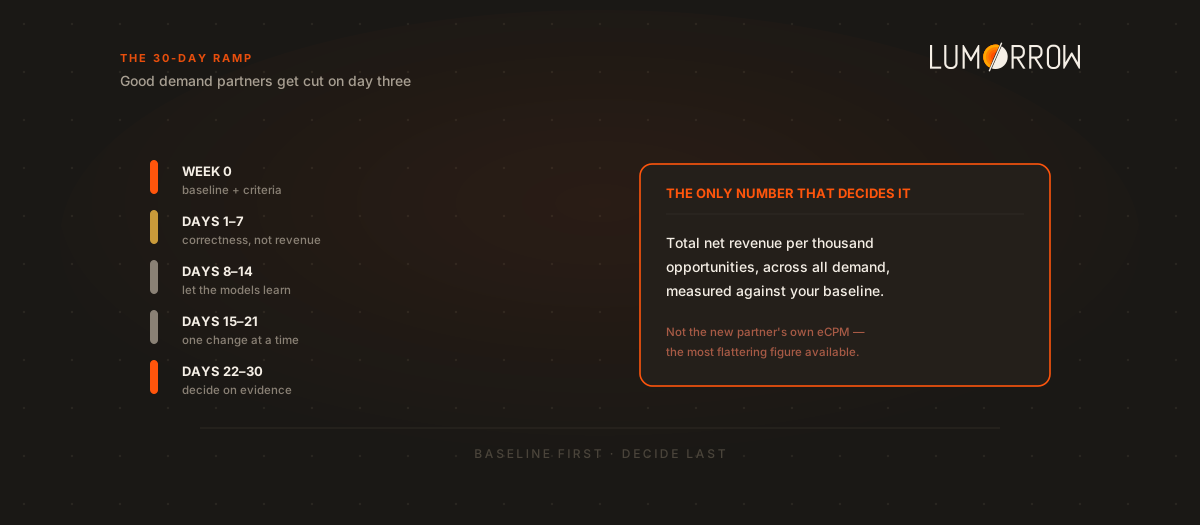
The most common way a good demand partner gets cut is being judged on day three.
Bids are thin at first. eCPM looks worse than the incumbent. Someone senior asks whether the integration was worth it, and the tag comes out before the partner’s models have seen enough of your inventory to bid properly on it.
The opposite failure is just as common: leaving a partner running for eight months because nobody agreed what success looked like, so nobody can say whether it arrived.
Here’s a 30-day structure that avoids both.
Week 0 — before the tag goes live
This is the step people skip, and it’s the one that makes the other four weeks interpretable.
- Record a baseline. Revenue, eCPM, fill rate, and total impressions for the specific placements you’re about to change — for at least the previous two weeks, ideally matched to the same weekdays. Without this you will be comparing against a memory.
- Agree success criteria in writing. One sentence: this partner stays if, by day 30, it adds X to net revenue on these placements without degrading latency. Vague criteria are how these decisions become political.
- Get reporting access on both sides, and confirm you can pull the same date range in both systems.
Days 1–7 — correctness, not performance
Do not look at revenue this week. Look at whether the plumbing is right.
- Do both sides count roughly the same thing? Pull impressions from your ad server and theirs for the same window. A large gap on day one is nearly always a tagging or timezone problem, and it’s far cheaper to find now than during month-end reconciliation.
- Do creatives render properly across your real device and browser mix?
- Did page performance change? Check latency and timeout behaviour. A partner that adds revenue and 400ms is not obviously a win.
- Is anything visually broken? Ad sizes collapsing, layout shift, refresh misbehaving.
Performance in week one is noise. Correctness in week one is everything.
Days 8–14 — let the models see the inventory
Both sides are learning. Their bidders are working out what your inventory is worth; your own routing is working out where they win.
The temptation is to start adjusting floors immediately. Resist it for another week — you’ll be optimizing against a signal that hasn’t stabilised, and you won’t be able to separate the effect of your change from the effect of the ramp.
What to watch instead: bid density (are they bidding on most requests or a narrow slice?) and which buyers are showing up. If the partner is only ever bidding on your best geo, you’ve learned something useful about what they’re actually for.
Days 15–21 — start optimizing
Now change one thing at a time.
- Floors, by placement and format.
- Timeout allocation, if they’re consistently late.
- Placement and format mix — a partner weak on display can be strong on video.
Give each change several days. Changing three variables in one week produces a result you cannot attribute.
Days 22–30 — decide on evidence
Compare against the Week 0 baseline, and ask the question that actually matters:
Did total net revenue on these placements go up, or did this partner just take share from an existing one?
A new partner winning 20% of impressions at a strong eCPM has added nothing if it won them from a partner paying the same. The number to look at is total revenue per thousand opportunities across all demand on those placements — not the new partner’s own reported eCPM, which is the most flattering and least useful figure available.
The mistake almost everyone makes
Judging on eCPM alone. A partner with a high eCPM and low fill can be worth less than one with a modest eCPM that bids on everything. And a partner whose eCPM looks superb because it only bids on your premium placements may simply be cannibalising the demand you already had there.
Total net revenue per opportunity, measured against a baseline you recorded before you started. Everything else is a diagnostic.
The takeaway
Give a new demand partner 30 days and a structure: baseline first, correctness in week one, patience in week two, one change at a time in week three, and a decision in week four made on total net revenue rather than the partner’s own eCPM. The discipline that makes it work is entirely in Week 0 — a baseline you recorded and a success criterion you wrote down while nobody had an opinion yet.
Lumorrow gives publishers reporting granular enough to answer the cannibalisation question — revenue by placement, format, geo, and demand source, in real time. See how it works for publishers →