
When your direct demand is bidding against your own resellers
The same impression can reach the same buyer down four different paths. When it does, you don't get more competition — you get the cheapest version of the same bid. Here's how duplicate paths form, and how to find yours.
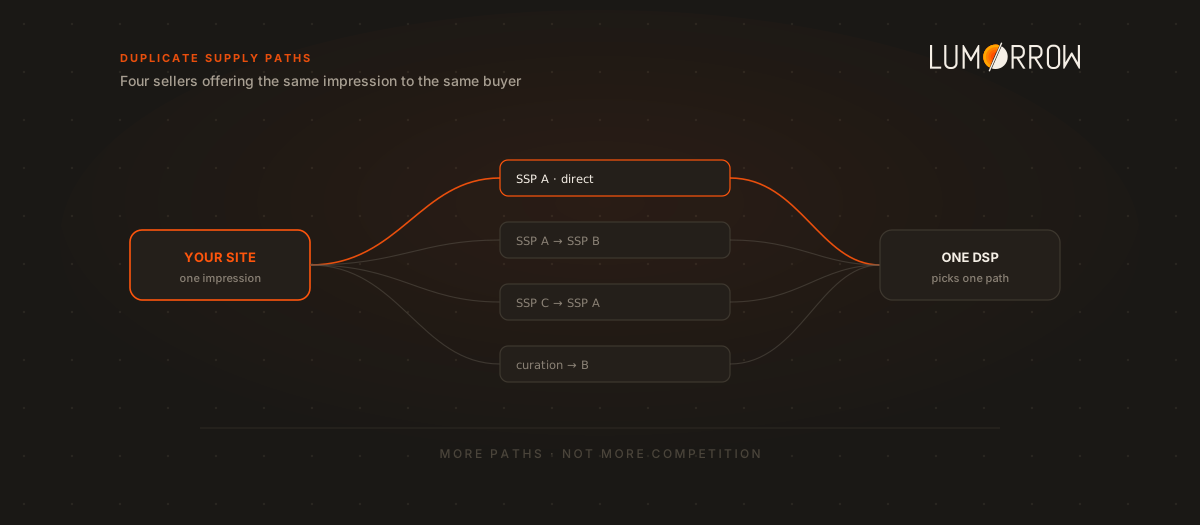
Here is a situation almost every publisher is in without having chosen it.
You integrate SSP A directly. Good — that’s a clean, short path. SSP A also has a reselling relationship with SSP B, so your inventory appears there too. Meanwhile you signed SSP C last year, and C buys some supply from A. And a curation partner you barely remember is packaging your inventory into a marketplace of its own.
One impression. Four sellers offering it. To, quite often, the same DSP.
That feels like competition. It usually isn’t.
Why duplication doesn’t create competition
The intuition is that more sellers means more bidders means a higher price. It breaks down for a few reasons.
Buyers deduplicate. DSPs running supply path optimization increasingly choose one path per publisher and ignore the rest. So four paths don’t produce four bids — they produce one bid, down whichever path the buyer prefers.
The path they prefer is the cheapest for them, not the best for you. A reseller path with an extra hop taking a fee can still be cheaper to the buyer if that hop discounts aggressively. You lose the margin, and you don’t win the impression at a better price.
Every hop takes a cut. The same clearing price nets you less down a three-hop path than a direct one. Duplication doesn’t just fail to raise the price — it routes revenue through more hands.
It costs you standing with buyers. Receiving the same impression from four sources looks like inflated supply, wastes buyer compute, and is one of the patterns traffic shaping exists to suppress. Publishers whose inventory arrives four times can find themselves throttled everywhere.
And it looks like something worse. From the buy side, an impression arriving down an unexpected path is indistinguishable from misrepresented inventory. The path just gets discounted or skipped, and nobody tells you why.
How to find yours
You already publish the map. It’s your ads.txt file.
Start with the RESELLER lines. Every one is a company authorised to sell your inventory that you are not selling to directly. For each, ask: who added this, which direct partner does it sit downstream of, and is that relationship still live?
Ask each direct partner the onward question. Do you resell my inventory, and to whom? Reputable partners answer plainly. The answer often surprises publishers who assumed a direct integration meant a single path.
Check the other side of the declaration. For each reseller, does their sellers.json actually list a relationship consistent with what your file claims? Reconciling the two is how you find lines that no longer correspond to anything real.
Then ask a buyer. If you have DSP or agency contacts, ask which path they take to your inventory and why. It’s the fastest way to learn that your direct integration is being bypassed — and it’s information you cannot get from your own reporting.
What to actually do about it
Resist the urge to delete everything that isn’t direct. Some reseller paths carry genuine, additive demand you would otherwise lose, and cutting blind kills working revenue.
The goal is not zero resellers. It’s no unnecessary duplication of the same demand:
- Consolidate where two paths reach the same buyers. Keep the shorter one.
- Make your direct path the most attractive one. If a buyer can reach you more cheaply and with better data directly, SPO works in your favour rather than against it.
- Fix the declarations. A reseller path you intend to keep should be correctly declared on both sides, so it isn’t discounted for looking irregular.
- Ask about onward reselling before you sign the next partner, before it becomes another line you inherit.
The takeaway
Duplicate supply paths form quietly, mostly through the onward reselling arrangements of partners you signed for good reasons. They rarely add competition, because buyers pick one path and ignore the others — and the one they pick is chosen for their economics, not yours. Your ads.txt RESELLER lines are the map. Read them, ask each direct partner what they do with your inventory downstream, then consolidate toward fewer, shorter paths rather than cutting indiscriminately.
Lumorrow buys direct from publishers and passes a complete SupplyChain object on every request, so the path a buyer sees is the one you actually authorised. See how it works for publishers →