
Seven bets on programmatic in 2027 — and what would prove us wrong
No trend list. Seven specific, checkable predictions for 2027 from the people running an exchange — built on the court rulings, benchmarks and traffic data of 2026.
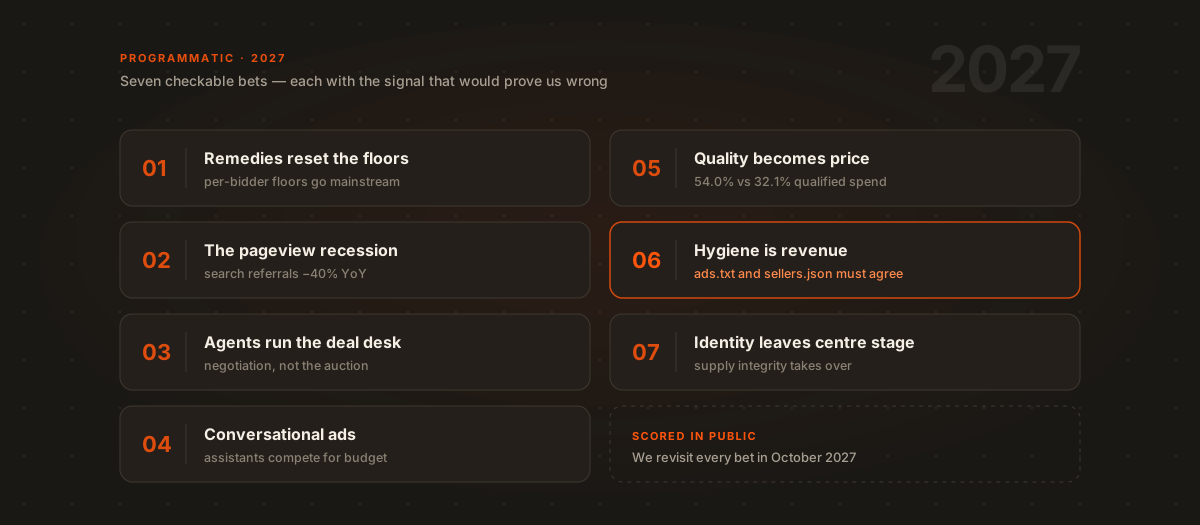
Every autumn the industry publishes its trend lists, and every list says the same things: AI, CTV, retail media, privacy. All true. None useful. A trend you can’t be wrong about isn’t a prediction, it’s a weather report.
So this is a different exercise. Below are seven bets we’re making about 2027. Each one comes with the evidence from 2026 that makes us believe it, and the signal that would tell us we got it wrong. In October 2027 we’ll come back to this post and score ourselves in public.
We run an exchange. That means we see the unglamorous middle of the market: bid requests, seller declarations, supply paths, the files nobody reads until something breaks. Our bets lean that way on purpose.
The backdrop: more money, fewer roads
The headline numbers for 2027 are healthy. Dentsu’s May 2026 forecast has global ad spend growth rising from 5.0% in 2026 to 5.5% in 2027, with retail media growing 11.4%. WARC is more bullish, at roughly $1.46 trillion for 2027. The industry isn’t short of money.
What it’s short of is open roads. In February 2026 Microsoft shut down Invest, the DSP it got with Xandr, and sent advertisers to Amazon DSP. Netflix, Disney and Amazon sell their streaming inventory through their own pipes. Google sent publishers 40.2% less search traffic in the year to July 2026, per Chartbeat. So more money is chasing a supply chain that’s getting narrower, more concentrated and more automated at once.
Each of our seven bets follows from that tension.
Bet 1: Google’s remedies arrive, and they change floors more than they change market share
The bet. In 2027 the US ad tech remedies take effect. The change publishers will notice first is mechanical: per-bidder price floors in Google Ad Manager, and AdX bids made available to rival ad servers. A collapse in Google’s share is not what they’ll see. By late 2027, setting different floors for different bidders will be normal practice, not an edge case.
Why we believe it. On 2 September 2026, Judge Leonie Brinkema declined to make Google divest AdX. She rejected all three structural remedies the DOJ asked for and accepted most of the proposed behavioral remedies, “as modified.” Google had already offered most of the behavioral package itself: real-time AdX bids made available to rival ad servers, letting publishers set different floors for individual bidders, and no first-look or last-look bid adjustments. It quietly removed Unified Pricing Rules from Ad Manager in December 2025, ahead of any order. The parties filed a joint proposed final judgment on 2 October 2026. The DOJ wants six months for the key changes and Google wants twelve, so either way they land in 2027.
Europe remains the wildcard. The European Commission fined Google €2.95 billion in September 2025 and has said that “only the divestment by Google of part of its services” would resolve the conflict of interest. Google answered with the same behavioral offer it made in the US. The Commission hasn’t ruled on it.
What would prove us wrong. The EU orders a structural separation that actually takes effect in 2027. Or the final US judgment comes back with teeth that the September order didn’t show.
What it means. Per-bidder floors are powerful and dangerous in equal measure. Used well, they price each demand source on what it’s actually worth. Used carelessly, they suppress the bids you most need. Publishers should start logging bid density by partner now, so they have a baseline when the controls arrive.
Bet 2: The pageview recession becomes the open web’s main supply story
The bet. In 2027, falling referral traffic will hurt open-web supply more than any privacy change or regulation. Fewer pageviews means fewer impressions. More and more independent publishers will make up the gap with content licensing and AI-access revenue, and some will make up for it with ad density, which is the bad option.
Why we believe it. Chartbeat’s 2026 Publisher Playbook shows Google Search referrals down 40.2% year on year across its network from July 2025 to July 2026. That’s nearly double the previous year’s 21.9% decline. Discover fell 34.3%. AI chatbots, which were supposed to make up the loss, sent 0.01% of traffic in the same data. Axios reported that small publishers lost about 60% of search referrals over two years. SparkToro, using Similarweb data, puts zero-click searches at 68% in early 2026.
The industry has started building the other revenue line. The IAB Tech Lab published its Content Monetization Protocols (CoMP) spec for public comment in March 2026, with cost-per-crawl pricing and an LLM ingest API. Its bot and crawler management guidance followed in May.
What would prove us wrong. Search referrals stabilize through the first half of 2027, which some early-2026 data hinted at. Or AI referrals grow into a real traffic source, low single-digit percentages rather than hundredths of a percent.
What it means. Watch for MFA growth. Squeezed publishers are tempted to add ad slots and buy traffic, and buyers already notice. In the ANA’s Q1 2026 benchmark, MFA exposure rose to 1.1%, up from a 0.4–0.6% range through 2025. Small numbers, but heading the wrong way.
Bet 3: Agents take over deal-making, not the auction
The bet. By the end of 2027, a meaningful share of private marketplace and programmatic guaranteed deals will be discovered, negotiated or set up by software agents. The millisecond auction will stay where it is: OpenRTB, run by bidders, not language models.
Why we believe it. The standards came together fast. The IAB Tech Lab merged its agentic work under one name, AAMP, in early 2026. Its Agent Registry went live in March and had 10 entries within days, including Amazon Ads, PubMatic and Equativ. The AAMP 2.0 release includes Buyer and Seller Agent SDKs that “can negotiate with each other, or share an agreed rate card,” with human approval steps built in. Separately, AdCP launched in October 2025 with Yahoo, PubMatic and Triton among its founding members. It’s built on Anthropic’s Model Context Protocol and designed for workflows that don’t need to happen in milliseconds.
The two camps don’t agree on much. They do agree on where agents belong: the slow, high-value layer of discovering inventory, comparing rate cards and setting up deals. The Tech Lab’s Agentic RTB Framework touches the auction, but by moving bidder logic into containers to cut latency. It doesn’t put an LLM in the loop.
What would prove us wrong. A major SSP or DSP puts a language model directly in the bid/no-bid path at scale. Or agent adoption stays stuck at demos and press releases through 2027.
What it means. An agent makes its decisions from whatever machine-readable truth it can find. For a seller, that means sellers.json, ads.txt, deal metadata and registry entries. A human media buyer might wave a messy declaration through. An agent will simply skip it. Bad data used to be friction. In 2027 it gets you excluded.
Bet 4: Conversational ads compete for budget with the open web
The bet. In 2027, ads in AI assistants become a real line item in performance budgets. Much of that money will come out of open-web display and lower-funnel programmatic, not out of search.
Why we believe it. It happened quickly. OpenAI started showing ads in ChatGPT in February 2026, at a reported CPM of about $60 with large minimum spends. On 5 May it opened a self-serve Ads Manager to US advertisers with CPC bidding and conversion tracking. In September it expanded to markets in Europe, India and the Middle East. Prices fell as volume grew, with reports of CPMs falling well below the launch rate within months. That’s how a new channel grows into a mainstream one.
What would prove us wrong. Conversational ad prices hold at premium levels because performance doesn’t justify scale. Or a privacy or trust backlash slows the rollout.
What it means. Display buyers have a new comparison. An assistant ad arrives with the user’s intent stated in plain language. An open-web impression has to justify its price against that, which means proving it’s real, viewable, in a quality context and bought through a clean path.
Bet 5: The quality gap becomes a price gap
The bet. In 2027 the gap between advertisers who buy programmatic well and those who buy it badly gets wider and more visible. Supply paths that can prove their quality will win a measurable price premium, not just “preferred” status.
Why we believe it. The ANA’s Q1 2026 Programmatic Transparency Benchmark found that top-performing advertisers turned 54.0% of spend into qualified impressions, against 32.1% for the bottom group. That 21.9-point gap is the largest the benchmark has recorded. The striking part is where the gap comes from. Transaction costs differed by only 2.4 points between the two groups. Media quality explained almost all of it. Measured on true cost per thousand qualified impressions, top performers paid $7.46 and bottom performers $19.04. A $1.95 gap in headline CPM became an $11.58 gap once waste was counted.
In other words, the “ad tech tax” debate has been looking at the smaller number. Fees matter. Buying the wrong impressions matters about eight times more.
What would prove us wrong. The benchmark gap narrows through 2027 without buyers changing how they select supply. That would suggest the gap was noise, not a structural difference.
What it means. A seller’s best pricing argument in 2027 is verifiability. Expect curated deals, verified supply paths and clean declarations to show up in bid prices, not just in deal names.
Bet 6: Supply-chain hygiene becomes a revenue variable, and most of the market isn’t ready
The bet. In 2027 the gap between what publishers declare and what’s actually true becomes a direct revenue problem, measured and priced by buyers and their agents. Most publishers will find out they have a problem only after the discounts have started.
Why we believe it. The files meant to make the supply chain checkable often don’t agree with each other. When HUMAN Security ran a supply-chain diagnostic in November 2023, the weakest result was the match between the supply chain declared in bid requests and sellers’ published sellers.json files. They agreed only about 50% of the time.
In September 2026 the industry made cleaning this up official. The Programmatic Governance Council, published through the IAB Tech Lab, released Programmatic Best Practices v1.0. Its baseline section asks every participant to keep ads.txt and sellers.json current. Another section tells sellers outright: “Do not engage in replication” of bid requests. The document is voluntary, but buyers now have a shared reference for what clean supply looks like.
The failures that cause mismatches are rarely dramatic:
- A publisher’s ads.txt lists a seller ID that the exchange’s sellers.json doesn’t contain, often because two systems issued IDs differently.
- ID schemes that truncate or derive IDs from hostnames, so different domains end up sharing an ID that buyers can’t tell apart.
- New partners declared in sellers.json long before every publisher has added the matching ads.txt line, or the reverse.
- ads.txt files that return errors, block crawlers, or haven’t been touched since the person who maintained them left.
None of this is fraud. It’s ordinary operational drift, and that’s the problem. From the buy side, drift looks the same as spoofing. If a buyer’s crawler finds an impression whose seller ID doesn’t match the publisher’s ads.txt, it discounts the impression or drops it, and no one ever explains why. Agents (Bet 3) make this stricter, because they don’t make exceptions.
What would prove us wrong. Buyers keep pricing on domain and audience while ignoring whether declarations match, and seller-ID mismatch rates fall through 2027 without anyone forcing the issue.
What it means. Treat your ads.txt and every exchange’s sellers.json entry for you as production systems, not paperwork. Check them on a schedule. Check them again whenever a partner hands you new IDs.
Bet 7: Cookies stay, and identity stops being the main story
The bet. 2027 will be the first year in about a decade when “what replaces the cookie?” isn’t the question everyone in programmatic is arguing about. Signal loss continues unevenly, but the industry’s attention moves to supply integrity and auction transparency.
Why we believe it. Google ended the deprecation drama itself. Chrome kept third-party cookies under user choice, and Google retired most Privacy Sandbox APIs in October 2025. Safari and Firefox still block them, and consent rates still vary by market, as we covered in our mid-2026 look at Privacy Sandbox. But there’s no longer a looming deadline to plan around. The cookie isn’t safe. It’s just stopped being news.
The questions that took its place are about the auction itself. How many times is the same impression being sold? The ANA’s 2026 data shows quality, not fees, as the swing factor. Prebid’s 2025 change to bidder-specific transaction IDs is still disputed. Bid duplication remains common. All of these are supply questions, not identity questions.
What would prove us wrong. A major browser or regulator triggers a new cookie cliff in 2027. Or a US federal privacy law resets the identity debate.
What it means. Identity budgets and roadmaps that were built around a Chrome deadline need to be rethought. Put the money toward knowing exactly what you’re buying and who you’re buying it from.
The common thread
Line the seven bets up and they say the same thing. In 2027, programmatic gets judged on what it can prove. Regulators want auctions they can audit. Buyers want quality they can measure. Agents need declarations they can parse. Publishers losing traffic need every remaining impression to clear at its true value. None of that works when the supply chain rests on files that disagree with each other.
That’s the bet we’ve built Lumorrow on: an exchange where the supply chain is checked continuously, not assumed, and where the shortest honest path between a publisher and a buyer is the product, not an afterthought.
We’ll score these in October 2027. If we’re wrong, you’ll read it here first.
Sources
- Dentsu global ad spend forecast, May 2026, and WARC global ad spend forecast, October 2026 (as summarized in Auxoads’ 2027 forecast roundup)
- AdExchanger, “Google Won’t Have To Break Up Its Ad Tech Business, Judge Brinkema Rules”, September 2026
- Relevant Audience, “Judge rejects AdX divestiture in DOJ ad tech case”, September 2026
- The Next Web, “A US court says Google keeps its ad exchange. The Commission said only a sale would work”, September 2026
- Search Engine Journal, “Google Search Decline Steepened To 40% YoY For Publishers” (Chartbeat 2026 Publisher Playbook), September 2026
- ANA, “Programmatic Transparency Benchmark Reveals Widening Gap Between Top and Bottom Advertisers”, May 2026
- IAB Tech Lab, “AAMP 2.0 Release Brings Transaction-ready Buyer and Seller Agent SDKs”, 2026
- PPC Land, “IAB Tech Lab’s agent registry hits 10 with Amazon and new deployment types”, March 2026
- AdExchanger, “The IAB Tech Lab Releases Its First Framework For Agentic Ad Buying Standards”
- PPC Land, “IAB Tech Lab’s CoMP spec forces LLMs to pay before they crawl”, March 2026
- Search Engine Journal, “OpenAI launches self-serve Ads Manager for ChatGPT”, May 2026
- Digiday, “Microsoft Advertising is closing the Xandr DSP”
- Engadget, “Google has killed Privacy Sandbox”, October 2025
- PPC Land, “IAB Tech Lab sets rules to curb duplicate ad bid requests industry-wide” (Programmatic Best Practices v1.0; HUMAN Security 2023 diagnostic), September 2026
Lumorrow is an AI-native exchange built for verifiable, short supply paths across web, CTV and OTT. See how the platform works → or explore what it means for publishers →.